ENGLAND AND WALES
PLANNING PERMISSION


PLANNING PERMISSION

CORE TOPICS:
- Planning permission and when it is required.
- Special considerations applicable to non-developed land.
- Material changes of use.
- Environmental Impact Assessments (EIAs), including for forestry
KEY TAKEAWAYS:
- Planning permission:
- Planning permission will be required for any “development” or material change in the use of land (by reference to standard use classes).
- Development or change of land use on agricultural or forestry land benefits from certain exemptions.
- Environmental impact assessments:
- The main EIA regime is unlikely to apply to the majority of rewilding activities.
- A forestry EIA may be required for activities including afforestation and deforestation.
ENGLAND AND WALES
PLANNING PERMISSION
1. INTRODUCTION
Rewilding projects will often be accompanied by development, whether in the form of ancillary building works or conversion of land or buildings for commercial, educational, or ecological purposes. Planning permission and environmental impact assessments (“EIAs”), both of which are integral to successful and sustainable development, should be at the forefront of rewilding practitioners’ minds when preparing for and carrying out any such development.
Practical scenarios
This note considers how the planning permission and EIA regimes apply to the following practical scenarios.
REWILDING PROJECT A
Landowner A holds mixed land in England. Some of the land is arable on which Landowner A currently grows cereal crops, some of it is pasture on which she grazes sheep and cattle.
There is also a large area of upland heath where the sheep graze in the summer months. Part of this is a site of special scientific interest (“SSSI”) since it is important foraging territory for raptors and a good example of dwarf-shrub heath plant communities.
Finally, there is a 4-hectare plantation of mature larch.
Landowner A intends to:
Stop growing cereal on her arable land and allow natural succession, plant a few individual trees and allow extensive grazing with the purpose of creating a shifting mosaic of habitats. It will be a dynamic habitat, neither permanently woodland, scrub or open. Selective tree planting and grazing are tools used to realise that purpose.
The fences in the ex-arable land will be removed and gaps broken into hedges so that the exarable land can be extensively grazed.
About 1 hectare will be fenced off and made into a campsite with yurts in the summer months and a permanently plumbed-in toilet block;
Continue to graze the grazing land together with the ex-arable land with ancient breed cattle and sheep. The livestock will graze extensively and become hefted.
The ex-grazing area will be nudged towards developing into woodland pasture. Some of the individual trees and clumps of trees will be fenced off to protect them from the stock. The cattle and sheep will be sold for meat;
Block the land drains on her upland heath with the aim of rewetting the peat. This may cause seasonal heathland ponds to appear; and fell the larch and, again, allow natural succession under grazing, to create native woodland pasture.
REWILDING PROJECT B
Landowner B is the freeholder of land in England none of which is part of a “sensitive area”. Although most of the land has been converted into rewilding land, 5 hectares continue to be arable land. Landowner B grows a variety of vegetables and cereals on the arable part which are being sold in the farm shop located on the land. The farm shop also sells honey produced on the neighbouring farm.
There is also a barn and several sheds situated near the front end of the land and in walking distance from the farm shop. The barn and sheds were formerly used to lamb and shear sheep and house cattle in winter. These are now idle.
Landowner B intends to:
- expand the size of the farm shop to meet the increased demand he has experienced over the last three years;
- convert the idle barn into a café;
- pave over the track from the public road to the barn to facilitate future access to the café;
- demolish the idle sheds and use the area for parking; and
- construct a small, temporary bird hide, for winter bird watching together with a short, raised wooden walkway to access the hide.
REWILDING PROJECT C
ENGLAND AND WALES
PLANNING PERMISSION
2. PLANNING PERMISSION
The planning system regulates “development” and planning permission is the official approval from a local planning authority (the “LPA”) to carry out operational development or changes of land or building use. Planning permission will not be required where rewilding activities (or activities ancillary to rewilding projects) fall outside the scope of the definition of “development” or benefit from permitted development rights. Given the intricacies of applications for planning permission and associated material considerations, advice should be sought from the LPA via the local council responsible for the land on the relevant requirements for planning permission.
This sub-section covers the aims of the planning system, when planning permission is required, the meaning of “development”, special considerations applicable to non-developed land, permitted development rights and an overview of the planning permission application process. Practical scenarios are considered throughout this sub-section to demonstrate when rewilding activities (or activities ancillary to rewilding projects) may require an application for planning permission.
2.1 What are the aims of the planning system?
- The English and Welsh planning systems control development which affects land and the use of land.
- The UK Government’s planning policies for England are set out in the National Planning Policy Framework1 (the “NPPF”). The NPPF emphasises that the English planning system seeks to contribute to “the achievement of sustainable development” by way of pursuing economic, social and environmental objectives. The English planning system’s environmental objectives include the protection of the environment, prudent use of natural resources and improvement of biodiversity, amongst others.
- The UK Government carried out a consultation on the proposals for reform of the planning system in England and launched a concurrent consultation on changes to the current planning system between 6 August 2020 and 29 October 2020.2 The UK Government is yet to publish the outcome of the consultations.
- The LPA is required to consider the NPPF when drawing up its vision and strategy for development of the area for which it has authority, in the form of a development plan. Any application for planning permission must be decided in accordance with such a development plan. Additionally, the LPA is required to take the NPPF into account as a material consideration when deciding planning applications.
- The Planning Policy Wales3 (the “PPW”) sets out the planning policies of the Welsh Government. The PPW aims to “ensure that the planning system contributes to the delivery of sustainable development and improves the social, economic, environmental and cultural wellbeing of Wales” pursuant to the Well-being of Future Generations (Wales) Act 2015.
- The Welsh planning system is also development led and built on a National Development Plan, Strategic Development Plans at a regional and sub-regional level and Local Development Plans at a local level. As such, the PPW should be read in conjunction with Future Wales4, the Welsh Government’s National Development Framework.
2.2 When is planning permission required?
Planning permission is required for the “carrying out of any development on land”.5
For the purposes of planning permission, “development” is given a wide meaning and includes:
- the carrying out of building, engineering, mining or other operations in, on, over or under land (“operational development”); or
- the making of any material change in the use of any buildings or other land (“material change of use”).
Given that many rewilding projects will involve agricultural land and that agriculture is treated as a special category under the planning legislation, it may be helpful to summarise the general scheme of the planning legislation and the place of agriculture and related rewilding activities within that general scheme:
- Agriculture (and forestry) is excluded from the definition of “development” under the Town and Country Planning Act 1990 (the “TCPA”), meaning that in many instances activities that fall within the definition of agricultural or forestry do not require planning permission;
- Agriculture is widely defined in the TCPA (see below) and a change from one of the activities within that definition (say, growing arable crops) to another (say, grazing animals) will be unlikely to constitute a “material change of use” (discussed below) under the TCPA. Whether or not grazing animals as part of a rewilding project will constitute “agriculture” will be fact dependent – see the practical examples discussed below;
- Subject to various exceptions, if agricultural land is put to a new use, i.e., a use that falls outside the definition of agriculture (e.g., if a camp site is opened on the land), then that may be considered a material change of use and planning permission would be required;
- Subject to various exceptions, if a rewilding project involved an “operational development” (see below) such as building a new building, it would require planning permission; and
- Some types of activity that would otherwise fall within the definition of “development” are expressly permitted without the need for permission to be obtained. This is called “permitted development” (described below). If the rewilding activity falls within a permitted development, then planning permission will not be required.
If in doubt as to whether planning permission is required, advice should be sought from the LPA via the local council responsible for the land, as a wrong decision at the initial
ENGLAND AND WALES
PLANNING PERMISSION
stage could cause significant delays, require rectification action incurring significant cost or even require any development to be reversed completely
2.3 What is operational development?
The meaning of “operational development” provided in legislation is discussed below. Each LPA may apply and interpret these provisions differently for a number of reasons, which may lead to the same activities requiring planning permission in one LPA area and not requiring it in a neighbouring area. Such discrepancy is perhaps more likely to occur for rewilding projects which are undertaking activities that may not be familiar to LPAs.
Operational development includes:
- Building operations, defined as the demolition of buildings or parts thereof, rebuilding, structural alterations of or additions to buildings or parts thereof, and other operations normally undertaken by a person carrying on business as a builder (which could include the simple act of erecting scaffolding).
Beyond the obvious examples of building a new structure to house a research facility or to facilitate monitoring of rewilding or extending an existing structure, this may also include the demolition of buildings (depending on the LPA and the building to be demolished). It may also include any temporary or interim structures erected or brought onto the land such as portacabins (this depends on the size and nature of the structure as well as the length of time it will be on the land for);
- Engineering operations, which are likely to include earthworks and the construction of lakes and ponds. It appears that LPAs take different approaches on whether or not ponds and scrapes etc. constitute operational development and in many cases, the determination may be impacted by wider factors such as the local development plan, other proposed works and the scale of the proposed pond etc.
- Mining operations. This is more relevant to the extraction of minerals from land and therefore unlikely to be relevant to rewilding in and of itself; and
- Other operations. This term is not defined in legislation, but it has been suggested that the erection of wooden stakes to mark out plots of land as well as the construction of poultry units may qualify as other operations. Given the breadth of this element of operational development and its previous interpretation, it may apply to a wide range of temporary structures, even ones used in transitioning the land from its current use to its natural use. Careful consideration should be given to the process of rewilding including each individual stage of the process.
EXAMPLE 1: FENCING
The removal of the fences from the ex-arable land in Rewilding project A would be unlikely to be considered “development”.
The construction of the fences around the campsite and trees in Rewilding project A may, however, constitute “development”. Notwithstanding, Landowner A may benefit from permitted development rights in this regard (for further detail below).
EXAMPLE 2: LAND DRAINAGE
A should consult with the relevant LPA in advance of undertaking such drainage works.
Whether or not specific rewilding actions, for example, creating intentionally ‘leaky’ dams and breaking up underground land drains would be considered to be minor works (and therefore not constitute development) will depend upon the specific circumstances of the project in which they are carried out, the scale of the activity and its likely impact.
Landowner A should also consider whether additional watercourse consents may be required from either the Environment Agency or the appointed local flood authority, depending on the nature of the land in question. The detail of these consents is beyond the scope of this briefing note.
EXAMPLE 3: PERMANENT TOILET BLOCK
EXAMPLE 4: EXTENSION OF FARM SHOP
ENGLAND AND WALES
PLANNING PERMISSION
EXAMPLE 5: OTHER DEVELOPMENT
EXAMPLE 6: CONVERSION INTOcAN EDUCATION FACILITY
EXAMPLE 7: TEMPORARY BIRD HIDE
EXAMPLE 8: CONVERSION INTO A CAFÉ
EXAMPLE 9: CAMPSITE
EXAMPLE 10: FARM SHOP
2.4 What is a material change of use?
A change of use of land or buildings requires planning permission if it is material. This is usually a question of fact and degree to be decided by the LPA.
The Town and Country Planning (Use Classes) Order 19876 (the “UCO”) sets out categories of building or land use (known as “use classes"7 ) which may be used to determine whether an application for planning permission is required. Use classes that may be relevant to certain rewilding projects include uses such as retail, food and drink, business, hotels and learning and non-residential.
The UCO also provides a non-exhaustive list of certain types of land use that do not fall within a particular use class (referred to as “sui generis use”). Sui generis use includes drinking establishments, hot food takeaway and caravan sites, amongst others.
The following changes of land or building use qualify as “development”:
- a change of use from one use class to another use class;
- a change of use from a sui generis use to another sui generis use; and
- a change of use from a sui generis use to a purpose within a use class.
A change of use from one purpose within a given use class to a different purpose within the same use class does not constitute “development”.8
EXAMPLE 11: CAFÉ
ENGLAND AND WALES
PLANNING PERMISSION
EXAMPLE 12: EDUCATION CENTRE
EXAMPLE 13: CONVERSION FROM SHEDS INTO PARKING
2.5 Are there any special considerations applicable to non-developed land?
The approach of the planning system to non-developed land (which may include agricultural land and forestry) is complex but the following considerations may be relevant to rewilding practitioners in guiding their approach to rewilding-related planning issues.
Operations and land use excluded from “development”
Certain operations or land uses may be excluded from the definition of “development”, meaning that planning permission is not required. These include “the use of any land for the purposes of agriculture or forestry (including
afforestation) and the use for any of those purposes of any building occupied together with land so used”.9
- For the purposes of planning permission, agriculture includes horticulture, fruit growing, seed growing, dairy farming, the breeding and keeping of livestock (including any kept for the production of food, wool, skins or fur, or for the purpose of its use in the farming of land), the use of land as grazing land, meadow land, osier land, market gardens and nursery grounds, and the use of land for woodlands where that use is ancillary to the farming of land for other agricultural purposes.10
- There is limited statutory guidance on the meaning of “forestry” or “afforestation”. The Forestry Commission, however, suggests that afforestation entails the conversion of a non-woodland use such as agriculture into woodland or forest by means of planting, or facilitating natural regeneration of trees to form woodland cover.11
Greenfield and brownfield land
The LPA may consider the rewilding land to be greenfield land, in which case it may be particularly restrictive as regards the grant of planning permission for future development on such land. Greenfield land constitutes previously undeveloped land which is not constrained by buildings or existing structures. Alternatively, if the land to be rewilding had previously been developed, it may be regarded as brownfield land. The LPA will likely want to encourage re-use of brownfield land, especially where such re-use would consist of rewilding activities.12
Agricultural land classification
The loss of land or quality of land from a proposed development, assessed by way of agricultural land classification (“ALC”), is of relevance in guiding planning decisions. ALC groups agricultural land into grades ranging from Grade 1 (excellent quality agricultural land) to Grade 5 (very poor quality agricultural land). This is because LPAs are minded to promote significant development on areas of poorer quality agricultural land (as opposed to higher quality agricultural land).13
Tree felling
Felling licences may be required for any development involving the felling of trees.
Tree felling is a legally controlled activity and a rewilder will normally need permission from the Forestry Commission14 to fell growing trees, who will usually provide this permission by issuing a felling licence. The licence will allow the rewilder to fell identified trees and woodland legally.
Not every tree felling project requires a felling licence. Exemptions can be based on: location; the type of tree work; the volume and diameter of the trees; felling of certain fruit trees, lopping and topping ;other permissions already in place; and legal and statutory undertakings. However, it is always advisable to seek advice from the Forestry Commission before any felling activity takes place.
There are more general good practice guidelines to help plan sustainable woodland management15 that control how tree management operations are carried out, which in turn will help prevent any damage to habitats or species and may be useful to flag certain complexities with rewilding projects that involve tree felling or areas with trees, more generally.
Other considerations relating to tree felling include:
- Tree felling in or near protected sites (such as SSSIs, Special Areas of Conservation (“SACs”) or Special Protection Areas (“SPAs”)) may require a separate consent from the relevant authority (usually Natural England and Natural Resources Wales) for the protected site. Often the Forestry Commission can help with the additional consent whilst processing a felling application;
- Larch felling – regulations exist to prevent the spread of pests and pathogens of trees and one of the more widely known pathogens is the one that affects larch species. A movement licence16 will be needed in order to safely move the timber from larch felling to prevent further pathogen outbreaks;
- Management plans to accompany licences – these are plans that provide a structured way to plan and
ENGLAND AND WALES
PLANNING PERMISSION
organise the sustainable management of woodland to a common industry standard. They are most useful for larger woodland holdings and long-term woodland management. These plans, which are intended to contain sustainable proposals of woodland management are often required before approval will be given for a tree felling licence; and
Possible restocking conditions on a licence to ensure regeneration of felled area – the government has a general policy against deforestation and so restocking conditions will normally be included in felling licences, other than for those licences approving areas to be thinned. Restocking proposals will be expected as part of a tree felling application.
A felling licence is transferable to a new landowner as long as there is no change to the felling or restocking set out in the felling licence. Any restocking conditions that apply to the land after a felling licence has been enacted remain in force after the land is sold. Those who sell land with a felling licence must advise the Forestry Commission and the purchaser accordingly.
A felling licence will usually contain permissions to fell trees for five years. However, a felling licence associated with a Forestry Commission approved woodland management plan is valid for 10 years.
EXAMPLE 14: SHIFTING MOSAIC OF HABITATS
The LPA may consider Landowner A to be putting the ex-arable land to forestry use by facilitating natural succession and the planting of trees. Such a change of use would be unlikely to require an application for planning permission as neither use falls within the scope of “development”
Additionally, if the land now being used to create a shifting mosaic of habitats is considered to have previously been developed (although unlikely where it was previously used for agricultural or forestry purposes), it may attract priority habitat status as an open mosaic habitat on previously developed land17. Key to the definition of open mosaics of habitat are (i) a previous disturbance to the site and (ii) the presence of unvegetated substrate and successional communities of sites and species such as mosses, open grassland and heathland.18
The LPA would be required to consider such priority habitat status and the imperative to maintain and enhance biodiversity in its determination on planning permission for future development on such land.
EXAMPLE 15: GRAZING OF THE LAND
EXAMPLE 16: FELLING OF THE LARCH
2.6 What are permitted development rights?
Certain types of development may benefit from general planning permission (referred to as “permitted development rights”21). The scope of permitted development rights is varied and complex and will need to be carefully considered on the facts of any relevant developments. However, the basic impact is that where a given development falls within the scope of a permitted development right, the applicant will be authorised to carry on the development without needing to apply to the LPA for planning permission.
The permitted development rights that specifically apply to agricultural and forestry developments vary depending on factors such as the area of land concerned and include developments such as building central grain stores, cattle sheds, on-farm reservoirs or facilities to store timber or forestry machinery. As these are unlikely to be relevant to rewilding land, they are not covered in further detail in this note. There are various other categories of permitted development rights relating to e.g., fencing and certain change of use which may be relevant to rewilding activities and some of these are highlighted using the practical scenarios below.
- Permitted development rights may be accompanied by specific conditions, non-compliance with which would place the development outside the category of permitted development rights.
- Permitted development rights may also be restricted or excluded altogether in certain circumstances, such as where the development is to take place in a
ENGLAND AND WALES
PLANNING PERMISSION
National Park (“NP”) and can be removed temporarily or permanently at the discretion of the LPA and Secretary of State.
- For some types of permitted development, the LPA may still need to give prior approval before works can commence.
EXAMPLE 17: ACCESSWAY TO THE CAFÉ
EXAMPLE 18: WOODLAND PASTURE
The LPA may consider the development of woodland pasture in Rewilding project A to qualify as agricultural use (“use of land for woodlands”) or forestry use (“conversion […] into woodland […] by means of planting, or facilitating natural regeneration of trees to form woodland cover”).
Additionally, as a priority habitat, wood pasture will be taken into account in the LPA’s determination on planning permission for future development on such land.
EXAMPLE 19: FENCING
EXAMPLE 20: CAMPSITE
EXAMPLE 21: CAFÉ
Provided the conversion of the agricultural barn into a café does not fall within one of the exceptions in schedule 2, part 3, Class R, TCP (GPD) Order 2015, Landowner B may benefit from these permitted development rights. Notwithstanding, the permitted development would be subject to the following conditions:
the café would qualify as a sui generis use;
Landowner B would be required to provide certain information to the LPA if the agricultural barn’s floor space did not exceed 150 square metres; and
Landowner B would be required to apply to the LPA for a determination as to whether prior approval of the LPA would be required if the agricultural barn’s floor space exceeded 150 square metres.
2.7 What are the different stages of the planning application process?
Where it has been determined that planning permission will be required, the planning application process will involve the following five stages:
- Pre-application advice: The LPA may offer preapplication advice on the requirements for and merits of the planning application. It is recommended that
such advice be sought to increase the chances of a successful planning application and reduce the time spent at the decision-making stage;
- Application: Most applications may be made online via the Planning Portal22 (for England) or Planning Applications Wales23 (for Wales), although hard copy applications are permitted. A valid application will include a completed application form, mandatory information including plans, drawings and proof of ownership, an application fee and any other information specified by the relevant LPA;
- Validation and registration: The LPA will validate the application as soon as is reasonably practicable. Once an application has been deemed valid, the application is placed on the planning register and assigned an application reference number. The LPA will notify the applicant of the application’s date of registration, contact details of the case officer and deadline for the application.
Where the LPA has deemed an application invalid, the LPA will notify the applicant of its reasons in writing and /or may request supporting information. An application may be deemed invalid for a number of reasons, including incomplete application forms or supporting documents, a missing application fee or incomplete plans. The application will usually have the right to appeal a non-validation decision; - Consultation and publicity: The LPA will consult various groups of consultees for a period that usually lasts 21 days (or longer where additional consultation is required). As part of such consultations, the LPA is required to seek the views of neighbours and local community groups.
The LPA will also be required to publicise the application for planning permission. Minimum publicity requirements depend on the type of development for which planning permission is sought. They will likely include site displays on or near the land to which the application relates, publication of notices in local newspapers, service of written notice on neighbours and announcements on the LPA’s website; and
ENGLAND AND WALES
PLANNING PERMISSION
- Consideration and decision-making: A case officer will consider the application, conduct site visits if necessary and prepare a report setting out his or her recommendations.
The LPA may choose to grant conditional or unconditional planning permission or refuse planning permission.
The applicant usually has the right to appeal against the decision or the conditions if his or her application for planning permission has been refused or has been granted subject to conditions. Where the LPA fails to determine the application within the relevant statutory timeframe (this is referred to as “non-determination”), the applicant also has a right to appeal to the SoS.
3. ENVIRONMENTAL IMPACT ASESSMENTS FOR DEVELOPMENT 24
EIAs aim to understand if a particular development will have an effect on the environment and how to implement measures that will mitigate any negative effects that a development may have on the environment.
EIAs are unlikely to be required for the majority of rewilding projects. The only clear exception to this is where a project involves the creation of a permanent campsite which is either over 1 hectare in size or is in or partially in a “sensitive” area. Where a project involves a significant amount of building works (such as a visitor centre, café and associated parking), advice should be taken on whether this could
constitute “urban development” for the purpose of the EIA regime and therefore require an EIA.
Given the intricacies of planning applications that require EIAs and material considerations relating thereto, where there is any uncertainty, advice should be sought from the LPA via the local council responsible for the land on the relevant requirements of an EIA and when an EIA will be required. Consulting with the LPA will provide a rewilder with certainty as to whether their rewilding project requires an EIA and the information that should be included in an EIA.
3.1 What is the purpose of EIAs?
EIAs aim to:
- protect the environment to ensure the LPA is aware of the likely significant effects a development/project may have on the environment; and
- ensure that the public and other applicable consultation bodies (e.g. Natural England)25 are given an opportunity to participate in the decision-making process.
The 2017 EIA England Regulations26 and 2017 EIA Wales Regulations27 (together the “2017 EIA Regulations”) set out a procedure for identifying developments that are subject to an EIA and the assessment, consultation and decision-making processes applicable to a development that requires an EIA in England and Wales.
3.2 When are EIAs required?
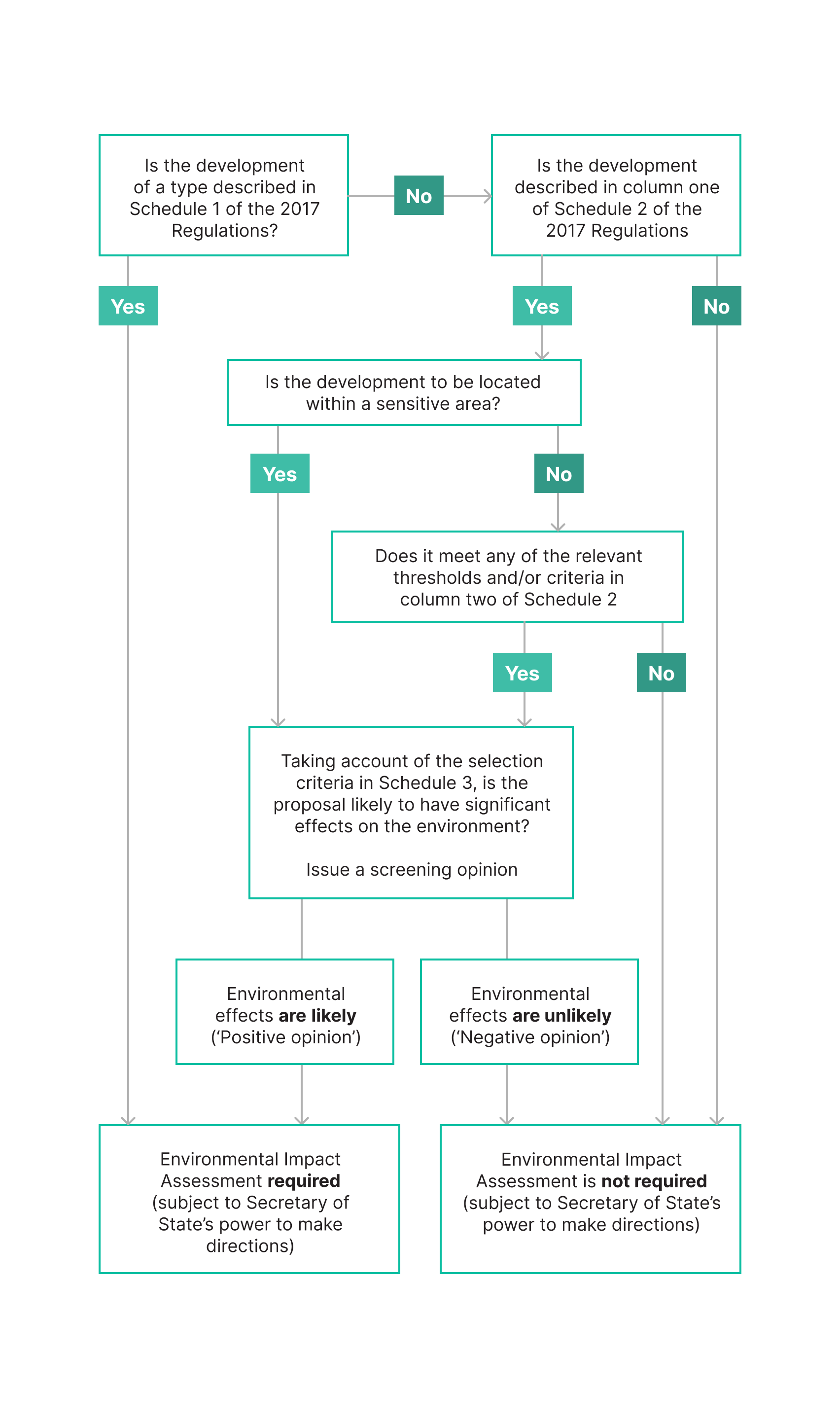
This flowchart available on the Government website is helpful in understanding when an EIA is required:
ENGLAND AND WALES
PLANNING PERMISSION
In summary, the EIA process begins with consideration as to whether or not development falls within the definition of either “Schedule 1 Development” or “Schedule 2 Development”, as defined in the Regulations.
This note does not address Schedule 1 Developments as they are large scale infrastructure projects which are therefore not relevant to rewilders.
It is possible (although unlikely) that some rewilding projects could be Schedule 2 Developments, in which case the next question is whether or not the development will have a significant effect on the environment.
More generally, both the LPA and the Secretary of State have discretion under Regulation 5 to determine whether or not a development is an EIA development even if it does not fully satisfy the criteria of Schedule 1 or Schedule 2 Developments.
3.3 What are Schedule 2 Developments?
Schedule 2 Developments include, for example, the use of uncultivated or semi-natural land for intensive agricultural purposes, water management projects for agriculture, urban development projects and the creation of permanent campsites, all of which must either cross a specified area of development threshold or be in or partially in any “sensitive areas” (see below). A full list of Schedule 2 Developments can be accessed using the link below in the endnote.28
It is unlikely that rewilders will undertake Schedule 2 Developments. A potential exception to this general rule is the development of permanent camp sites which are larger than 1 hectare in size or are in a sensitive area. Rewilders should also be aware that the Regulations have been interpreted broadly and although at first glance “urban development” does not appear applicable to rewilding projects, it has been interpreted broadly and could conceivably capture rewilding projects involving significant cumulative building works (e.g. where visitor centres, cafes and car parking, etc., are developed).
When assessing Schedule 2 Developments, there are three questions that can be asked to determine if your development requires an EIA:
- Is the proposed development within a category set out in Schedule 2?
- Does it exceed the threshold set out for that category in Schedule 2? Or is it located in or partially in a “sensitive area”?
- Is it likely to have a significant effect on the environment due to factors such as nature, size or location? (This will be assessed by reference to the criteria set out in Schedule 3 of the 2017 Regulations).
If the answer is yes to all three questions above, then the proposed development would require an EIA. The government has produced this useful table indicating the type or scale of Schedule 2 development that is likely to require an EIA.
If a rewilder is unsure if their project will require an EIA, they should always request the LPA to issue a screening opinion.
3.4 How do sensitive areas impact EIAs?
Sensitive areas under the 2017 EIA Regulations are:
- SSSIs and European sites;
- NPs;
- the Broads and areas of outstanding natural beauty (“AONBs”); and
- World Heritage Sites and scheduled monuments.29
Where a development is of a type listed in Schedule 2 and is in or partially in a sensitive area, the exclusion thresholds and criteria (in the second column of Schedule 2) are not applied. This means that when proposing to conduct any development listed in the first column of Schedule 2 that is in or partially in a ‘sensitive area’, the development must be screened by the LPA.
An LPA should consult with various consultation bodies (for example, Natural England or Natural Resources Wales) if it is uncertain as to the significance of a proposed development’s likely effects on a sensitive area. Natural England or Natural Resources Wales, as the case may be, should be consulted in respect of developments within SSSIs and European sites.
When considering the sensitivity of a location, an LPA or developer should also consider whether any nationally or internationally agreed environmental standards are already being approached or exceeded.
Separately, any activities being undertaken in, or sufficiently close to impact, a SSSI or a European site may require additional consents and assessments, such as a Habitats Regulation Assessment. See the Rewilding in England and Wales: Protected areas briefing note for further information on potentially additional relevant assessments for sensitive areas.
EXAMPLE 22: REWILDING PROJECT A
Rewilding project A may require an EIA for the yurts, depending on their nature:
Landowner A will be constructing a campsite with yurts for use in the summer months. The first test to consider is if this would be classified as a Schedule 2 Development.
The installation of a campsite would be a Schedule 2 paragraph 12(e) development if it were ‘permanent’ and the area of development exceeds 1 hectare.
If the campsite occupied an area of less than 1 hectare, it could still be a Schedule 2 Development if the proposed campsite exists within or partially in the SSSI on Rewilding project A which qualifies as a “sensitive area”.
The final question would be whether the construction of the campsite would have an effect
ENGLAND AND WALES
PLANNING PERMISSION
on the environment and this would be a question of fact and expert assessment.
If the above circumstances apply, Landowner A would be advised to request the LPA to issue a screening opinion before proceeding with the full EIA process. The LPA must respond within 21 days. The LPA will then decide if Rewilding project A would require an EIA.
The following actions in Rewilding project A are unlikely to require an EIA:
Any blocking of land drains with the aim of rewetting the peat is unlikely to be classified as a Schedule 2 Development, meaning that an EIA will not be required.30
Creating woodland pasture and felling any larch would not require an EIA under the 2017 EIA Regulations. A rewilder may be required to follow a separate application process under the Forestry Regulations (see below).
EXAMPLE 23: REWILDING PROJECT B
EXAMPLE 24: REWILDING PROJECT C
Landowner C will be converting a manor into an education centre.
On the realistic assumption that the education centre is not deemed to be an urban development of more than 1 hectare, then it is likely that it will not require an EIA.
4. EIAS FOR FORESTRY PROJECTS
4.1 When is a forestry EIA required?
The Environmental Impact Assessment (Forestry) (England and Wales) Regulations 1999 (SI 1999/2228) (“Forestry Regulations”) implement the EIA regime for forestry projects in England and Wales and set out whether a project is a “relevant project”.
If a project is deemed to be a “relevant project” then it will require consent from the Forestry Commission.
Rewilders should consult the Government guidance on forestry EIAs where they are undertaking forestry activities as the application of the Forestry Regulations is complex and beyond the scope of this note.
4.2 What is a “relevant project”?
Under the Forestry Regulations, afforestation, deforestation, forest road works and forest quarry works will be a “relevant project” where:
- a project is likely, by virtue of factors such as its nature, size or location, to have significant effects on the environment. Subject to specified exceptions30, it will be assumed that projects not exceeding relevant thresholds specified in Schedule 2 of the Forestry Regulations will not have a significant effect of the environment; and
- a project (i) does not involve “development” for the purposes of the planning permission regime; or (ii) involves “development” but is not identified in Schedule 1 or column 1 in Schedule 2 of the EIA Regulations; or (iii) involves “development” subject to specified permitted development rights.31
According to the Government’s guidance page, the four project activities mean:
- Afforestation – this means conversion of a nonwoodland land use, for example agriculture, into woodland or forest (these terms are used interchangeably) by means of planting or facilitating natural regeneration (self-sowing) of trees to form woodland cover. This can include both commercial proposals for short rotation coppice (SRC) and short rotation forestry (SRF), including energy crops and Christmas tree plantations and proposals solely for woodland or forest creation with no wider commercial purpose. Note that planting or natural regenerations of less than 0.5 hectares will not be considered afforestation under the Forestry Regulations.
- Deforestation – this means removal of woodland cover for conversion to another land use. This can include proposals for the removal of SRC and SRF, including the removal of energy crops and Christmas tree plantations;
ENGLAND AND WALES
PLANNING PERMISSION
- Forest road works – this means forest road projects that include the formation, alteration or maintenance of private ways on land used (or to be used) for forestry purposes, including roads within a forest or leading to one;
- Forest quarry works – this includes quarrying to obtain materials required for forest roadworks on land that is used or will be used for forestry purposes.
There are certain exceptions to what constitutes a ‘relevant project’, see the Government’s guidance for details.
4.3 What is involved in a forestry EIA?
There are two relevant application stages:
- By submitting a ‘Stage 1’ EIA application it is possible to confirm whether the Forestry Commission believes the project is likely to have a significant effect on the environment or not. There are three types of ‘Stage 1’ applications: Basic notification; Full Notification and Application for Opinion. The application type is determined by the project size and land sensitivity.
- Those projects that are determined at ‘Stage 1’ to have a significant effect on the environment will require a ‘Stage 2’ consent.
- If the project does not require a grant to create the woodland, and the Forestry Commission has said at ‘Stage 1’ that a ‘Stage 2’ EIA consent is not required, then a rewilder can begin to plant the woodland at that point. A decision should arrive within 28 or 42 days depending on the Stage 1 application type.
- Carrying out a forestry project without a ‘Stage 2’ EIA consent where it was required will leave a person liable to the Forestry Commission taking enforcement action against them. This may include, but is not limited to, requiring the person to restore the land to its previous condition at their own expense.
- Anyone with a new project should consult the Forestry Commission’s guidance table on thresholds32 because for afforestation for example, the total area of the
woodland creation proposal must be added to that of other nearby (within 500 metres) recent woodland creation projects (those completed within the past five years, including on other people’s land). The thresholds change depending on the land sensitivity e.g. sensitive land (like a local nature reserve). The land sensitivities can also be found in the same guidance note as the thresholds.
Thank you to Clifford Chance LLP for their legal support in producing this briefing note.
This publication does not necessarily deal with every important topic or cover every aspect of the topics with which it deals. It is not designed to provide legal or other advice. You should not assume that the case studies apply to your situation and specific legal advice should be obtained.
The hyperlinks to legislation, guidance and various other external sources within this briefing are correct as of 1 December 2022.
ENDNOTES
- https://www.gov.uk/government/publications/ national-planning-policy-framework–2.
- For further reading, see the consultation on changes to planning policy and regulations (https://assets.publishing.service.gov.uk/government/uploads/system/uploads/attachment_data/file/927157/200805_Changes_to_the_current_ planning_system.pdf) and the White Paper: Planning for the Future (https://assets.publishing.service.gov.uk/government/uploads/system/uploads/attachment_data/file/958421/Planning_for_the_ Future_web_accessible_version.pdf).
- https://gov.wales/planning-policy-wales.
- https://gov.wales/future-wales-national-plan-2040.
- TCPA, s 57(1) (https://www.legislation.gov.uk/ukpga/1990/8/section/57).
- https://www.legislation.gov.uk/uksi/1987/764/ contents/made. Note that the latest version of the UCO is not available on the Government’s official legislation website. The Planning Portal (for England) (https://www.planningportal.co.uk/permission/ common-projects/change-of-use/use-classes) and Welsh Government (https://gov.wales/planningpermission-use-classes-change-use) offer useful guidance on the UCO.
- Agricultural or forestry use currently does not fall within any of the statutory use classes provided for in the UCO.
- TCPA, s 55(2)(f) (https://www.legislation.gov.uk/ukpga/1990/8/section/55).
- TCPA, s 55(2)(e) (https://www.legislation.gov.uk/ukpga/1990/8/section/55).
- TCPA, s 336 (https://www.legislation.gov.uk/ukpga/1990/8/section/336).
ENGLAND AND WALES
PLANNING PERMISSION
- See Forestry Commission’s Guidance on Environmental Impact Assessments for woodland (https://www.gov.uk/guidance/environmental-impact-assessments-for-woodland).
- Refer to UK Government’s National Planning Policy Framework (https://assets.publishing.service.gov.uk/ government/uploads/system/uploads/attachmentdata/file/1005759/NPPF_July_2021.pdf”) and The Countryside Charity’s Annual State of Brownfield Report (https://www.cpre.org.uk/wp-content/ uploads/2021/11/Nov-2021_CPRE_Recycling-ourland_brownfields-report.pdf) for further information.
- See Natural England’s Technical Information Note TIN049 https://publications.naturalengland.org.uk/publication/35012
- https://www.gov.uk/government/organisations/forestry-commission.
- European Protected Species and woodland operations checklist (https://assets.publishing. service.gov.uk/government/uploads/system/uploads/attachment_data/file/697613/eps-checklist-v4.pdf).
- https://www.forestresearch.gov.uk/tools-andresources/fthr/pest-and-disease-resources/ramorumdisease-phytophthora-ramorum/phytophthoramanual-9-licences-to-move-and-process-wood-fromtrees-with-ramorum-disease/.
- See Natural Environment and Rural Communities Act 2006 (the “NERC”), s 41 9 https://www.legislation.gov.uk/ukpga/2006/16/section/41); Environment (Wales) Act 2016 (the “EWA”), s 7 (https://www.legislation.gov.uk/anaw/2016/3/section/7).
- See the UK Biodiversity Action Plan: Priority Habitat Descriptions (https://data.jncc.gov.uk/ data/2728792c-c8c6-4b8c-9ccd-a908cb0f1432/ UKBAP-PriorityHabitatDescriptions-Rev-2011.pdf
- Sykes v Secretary of State for the Environment and Another (1981) 42 P. & C.R. 19.
- For further reading, refer to the Forestry Commission’s Operations Note 23: Processing felling applications involving larch species
- Refer to TCP (GPD) Order 1995, sched 2 (https://www.legislation.gov.uk/uksi/1995/418/schedule/2) and TCP (GPD) Order 2015, sched 2 (https://www.legislation.gov.uk/uksi/2015/596/schedule/2).
- https://www.planningportal.co.uk/.
- https://gov.wales/planning-applications.
- For further reading on EIAs, see the briefing article prepared by Friends of the Earth, dated September 2020 (https://cdn.friendsoftheearth.uk/sites/default/files/downloads/September_2020_Environmental_ Impact_Assessment.pdf). This provides a useful guide on EIAs and provides various links to further reading materials.
- See regulation 2(1) of the 2017 EIA England Regulations (https://www.legislation.gov.uk/uksi/2017/571/regulation/2) and the 2017 EIA Wales Regulations which provide a list of the consultation bodies (https://www.legislation.gov.uk/wsi/2017/567/regulation/2).
- The Town and Country Planning (Environmental Impact Assessment) Regulations 2017
- The Town and Country Planning (Environmental Impact Assessment) (Wales) Regulations 2017
- https://www.legislation.gov.uk/uksi/2017/571/schedule/2
- See regulation 2(1) of the 2017 EIA Regulations (https://www.legislation.gov.uk/uksi/2017/571/regulation/2).
- See The Environmental Impact Assessment (Forestry) (England and Wales) Regulations 1999 (SI 1999/2228, Regulation 3(3)
- The Environmental Impact Assessment (Forestry) (England and Wales) Regulations 1999 (SI 1999/2228), Regulation 3(1)(c).

This note is part of a range of information produced by Rewilding Britain and The Lifescape Project to provide practical guidance to rewilders. Each is designed to help rewilding practitioners across Britain overcome common barriers in their rewilding journey, as identified through conversations with members of our Rewilding Network.
Rewilding Britain’s Rewilding Network provides a central meeting point for landowners, land and project managers and local groups in Britain, offering opportunities for collaboration and allowing smaller landowners to take on larger-scale rewilding together. If you find this useful, please consider joining the Network, where those in Britain can explore these issues further with others in the same boat.

The Lifescape Project is a rewilding charity using a multi-disciplinary approach to achieve its mission of catalysing the creation, restoration and protection of wild landscapes. Lifescape’s legal team is working to support rewilders in understanding how the law applies to their activities and pursuing systemic legal change where needed to support the full potential of rewilding. These notes form part of Lifescape’s Rewilding Law Hub which aims to provide a legal resource centre for those wanting to manage land in accordance with rewilding principles.
We’d love to hear what you’ve found useful in these notes and where we can help fill gaps in the guidance so that we can make sure they remain an up-to-date practical tool for rewilders.
Get in touch with us at: Rewilding Britain: the Rewilding Network, www.rewildingbritain.org.uk/rewilding-network
The Lifescape Project: Elsie Blackshaw-Crosby, elsie.blackshaw@lifescapeproject.org