
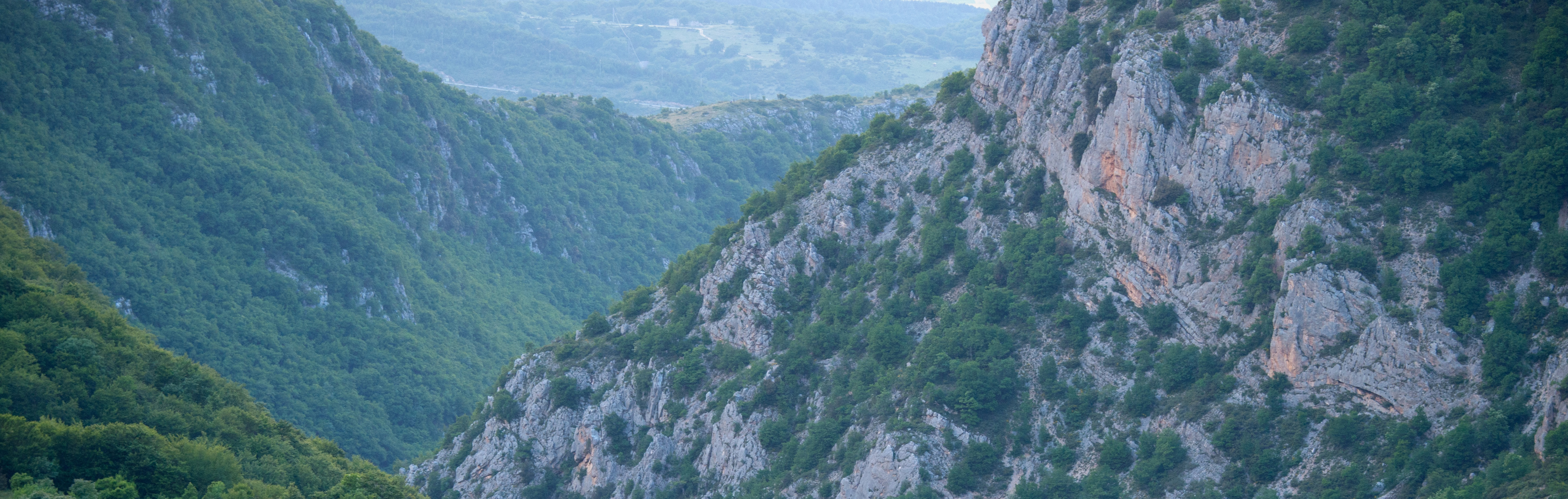


Rewilding in Italy
Public Access & Restrictions
Abandoned grazing land turned into wildlife watching area, Abruzzo, Lazio, and Molise NPs.
Staffan Widstrand / Rewilding Europe
Core Topics
- The rules on public and thirdparty access to private land
- Legal tools to grant access to privately owned land and ways to limit such access
- Rights on common land
- Grazing rights
- Unauthorised entry and trespassing
Key Takeaways
Table of Contents
1.
2.
5.
1. What rights do people have to enter and/or use land?
When it comes to public access, you need to consider the following two factors:
- whether the land is publicly or privately owned; and
- how and whether the public could benefit from being able to access or use the land.
1.1. Public Land
There are two broad categories of public land in Italy: state property and national heritage sites, which are in turn split into available and unavailable land. Different rights of access apply to each of these categories, as described below.
State property (demanio pubblico) refers to:
- Beaches and seashores, roadsteads and harbours, rivers, streams, lakes and other public waters;
- Any roads, aqueducts and areas of historical, archaeological, and artistic interest that are owned by the Italian state, provinces, municipalities, as well as cemeteries and municipal markets.
State property must be made accessible to the public. Individuals cannot acquire ownership of state property but may acquire rights to manage such land in the public interest, whilst continuing to ensure public access.1 Such land management rights are generally granted to individuals through public tender procedures.
National heritage sites include all other land and buildings owned by the Italian state, regions, provinces, municipalities, and other public bodies:
- Unavailable land (patrimonio indisponibile) serves public purposes or is intended for providing public services and includes forests, mines, quarries, peat bogs and areas of historical, archaeological, paleontological and artistic interest that do not constitute state property as per above.
Such land is intended to be used for a public service and this may include granting public access.2 Individuals may acquire ownership of unavailable land but must continue to provide public access and/or use. - Available land (patrimonio disponibile) provides income for local government and public bodies: e.g., leased land and woodland, or vacant land.
Available land is distinguished from unavailable land in that it is not actively used for a public service and is subject to the same rules as private land as regards use and transfer of ownership, so it can be transferred, and access can be granted under the same conditions as private land.
1.2. Private land
The general rule is that there is no public right of access to privately owned land in Italy and landowners may close their land off to the public with walls or fences and/or through signage.3
However, there are important exceptions to this rule that you should be aware of:
- There may be general state rights over privately owned land (diritti demaniali su beni altrui). This includes:
- Public easements;
- Government access to private land to construct public water supply or wastewater systems; or
- Civic uses which grant various types of public rights to local communities.
- Private land may be included in the register of landscape and heritage sites (beni paesaggistici).4 Public access is granted for such sites.
You may also grant public access to your land if you wish to. This can either be:
- A general right of access granted to individual/s; or
- An easement granted to neighbouring land (i.e., dominant land, as discussed in Section 2.4 below).
As a side note, if you do not own the land you are managing, you will need to check the terms of your contractual agreement with the landowner to determine whether or not you have the right to allow or forbid access, grant access rights or easements, erect fences etc.
If you do allow access, there are several practical steps you may take to minimise risks and associated liability:
- make the conditions under which access is permitted very clear and visual (e.g., a visual signage with rules: only leashed dogs / no dogs allowed, sticking to designated paths, not starting any fires, keep distance from the animals, etc.);
- undertake and keep up to date detailed risk assessments;
- have in place third-party insurance that specifically covers public access; and
- when in doubt or faced with a liability claim, seek legal advice.

Italian Dormouse/Hazelmouse, Lazio
Bruno D’Amicis / Rewilding Europe
1.3. Are there special rules in relation to natural landscapes?
Italian case law is contributing to the extension of public rights of access in relation to natural landscapes on a case-by-case basis. For example:
- According to the Court, landscapes of social and/or environmental interest are to be considered common property of all citizens (beni comuni), regardless of the type of ownership (public or private) over the land. In this case, the fishing valleys located in the Venetian Lagoon, in Veneto region, were declared the property of the Italian state in the interest of the public.5 The decision is an important building block in establishing that the collective right of the public to benefit from and protect natural landscapes may prevail over a formal title of ownership.
- The concept of common property has also been applied to finite natural resources which must be publicly accessible and in respect of which economic activity may be limited in the public interest.6 It is possible that biodiversity may be considered to be a finite natural resource.
- There have been instances in Italian case law of third parties purporting to have a “right of access to nature” (i.e., freedom to enter someone else’s land for hiking, mushroom picking, or similar recreational purposes, without causing damage to existing crops). However, such right does not exist in such general terms under Italian law and the general prohibition of access to private land remains.
1.4. How can I tell whether there is public access over land?
The status of land and whether or not it is subject to public access can be determined by consulting the following sources of information:
- Checking the interactive maps published online by the Ministry of Culture7;
- Consulting regional landscape plans (piani paesaggistici regionali);
- Requesting a certificate showing existing environmental, cultural or landscape restrictions from the local landscape protection service office of the province or region.
Example
Landowner A introduces wild horses to their project and is concerned about public access to the site during breeding season.
Assuming that the project is set up on private land, Landowner A has a right to close off their land to the public, including during specific times of the year and for as long as they wish.
However, Landowner A should keep the following in mind:
- Any decisions around access to the land must not restrict existing easements, e.g., if an easement requires that Landowner A’s land be accessible for a specific purpose all year round, such access should not be prevented. Therefore, any easement created through a contractual agreement should specify any limitations to the easement, e.g., periods or circumstances where access is not permitted.
- The Supreme Court decision regarding the Venetian Lagoon sets an important precedent that, under certain circumstances, private land may be considered “common property” and, as such, be open to the public. However, rewilding projects may not be affected by similar decisions as:
- It is unlikely that a Court would grant public access to land where such access may raise public safety or animal welfare concerns;
- Nature and biodiversity are a primary constitutional value and, as such, should prevail over access rights;
- In any case, such a decision would be made by a Court following careful consideration of competing interests over the land and would represent an exception to the general right to close off private land to the public.
2. Other than public access, when may third parties access private land?
This section applies to you if you own or are managing private land which is neither subject to state rights of access nor has a landscape / heritage site status (see section above).
Notwithstanding the general rule of there being no access to private land which is closed off, you may still have to grant access to your land to certain individuals, as outlined below.
2.1. Repair and recovery of property
You must allow access to your land whenever necessary to build or repair a wall or other structure owned by a neighbouring landowner, or jointly owned by both landowners.8 You may be entitled to compensation if such access causes any damage to your land. On the contrary, if you’re the one who needs to enter your neighbour’s land to repair a wall or structure, then you may be liable to compensate your neighbour for any damage caused.
You must also allow access to those who wish to recover an object of theirs that is accidentally found on your land (e.g., fruit from a tree belonging to a neighbouring landowner), or an animal that has escaped from their custody. In such cases, you may prevent entry to your land if you return the object or animal directly to its rightful keeper.9
2.2. Hunting and fishing
For information on hunting laws and how they may apply to rewilding, please refer to Rewilding in Italy: Hunting. However, in summary:
- Hunters are generally allowed access to private land. However, there are specific ways for landowners to block access to hunters.
- Hunting is forbidden on cultivated land10 where there is risk of damage to crops.11
- As regards any other private land, you should take the following steps to prohibit hunting activity on your land:12
- enclose the land with a wall, wire fence or any other effective enclosure that is at least 1.20 metres high, or a perennial water stream that is at least 3 metres wide and 1.50 metres deep;
- erect signage prohibiting hunting and clearly marking the boundaries of the land closed off to hunters; and
- notify regional authorities that the land is closed off to hunters.13
In contrast, accessing land for fishing purposes is only permitted with the landowner’s consent.

Apennine/Abruzzo chamois female watching over kid, Abruzzo NP.
Bruno D’Amicis / Rewilding Europe
2.3. Beekeeping
Beekeepers may recover bees that have escaped onto land owned by other landowners. However, if the beekeeper has not proceeded to follow the bees within two days or has ceased to follow them for two consecutive days, the landowner may keep the bees.
In any case, the beekeeper will have to compensate the landowner for any damage caused to the land.14
2.4. Easements
Easements (servitù) are often established in wild or wooded landscapes to create rights of way. Other common uses of easements are to grant passage to animals to reach grazing grounds or domestic or agricultural use of spring or reservoir waters. An easement requires two parcels of land with different owners which are close to each other, where one parcel of land (the dominant land) benefits from a right over the other parcel of land (the servient tenement).
Easements are either legal - where a landowner is legally entitled to an easement, which must be recorded in writing (either in a written agreement between the parties or through a court decision), or voluntary - where two landowners may decide to create an easement but there is no obligation to do so.
Any written agreement between the two landowners should clearly specify the nature of the easement and how it may be exercised. Note that, in case of ambiguity or doubt, the easement must be exercised in the least burdensome way possible for the servient tenement.15
An easement of passage (servitù di passaggio, “right of way”) may be created even if the land is closed off to the wider public16, granting a fellow landowner the right to pass through neighbouring land to enter their own land or to access public roads. Rights of way include:
- pedestrian rights of way;
- vehicular rights of way;
- human or animal-driven carts;
- motor vehicles.
This means that e.g. a pedestrian right of way does not automatically imply the right to pass through with carts or vehicles.17 If the dominant land is enclosed, it is possible to expand the right of way to include passage with vehicles where necessary for the purpose of the easement or for a new purpose the dominant landowner intends to use it for.18 However, the holder of the servient tenement may object to the extension, e.g. by pointing out that there is already another suitable and less cumbersome point of access.19 Ultimately, the interests of both landowners involved should be taken into account when deciding whether to expand an existing right of way.
From a practical perspective, any agreements establishing rights of way should specify which landowner is responsible for undertaking and paying for any work necessary to create the relevant footpath / vehicle track etc. If not, the beneficiary of the easement may be entitled to access the neighbouring land to carry out the necessary works at their own expense.20 If both land holdings benefit from the necessary works, there may be a legal entitlement for the parties to share the associated costs.21
Establishing new rights of way through neighbouring land or extending existing ones is often necessary for agricultural purposes. In such cases, Italian courts have shown consideration for the potential environmental implications of establishing rights of way and have put in place restrictions to ensure the protection of local flora and fauna.
Any changes to the land required as a result of the easement must be limited to what is strictly necessary to allow access to the dominant land. In turn, the holder of the servient tenement must not do anything to restrict the exercise of the easement or make it more inconvenient22.
For more information on easements, please refer to Rewilding in Italy: Obtaining and Protecting Wild Land.
3. What are the rules in civic uses land and how they may limit access?
Civic uses are common in mountainous areas and establish a type of collective ownership, allowing the local community access to the land for e.g., animal grazing, picking plants or mushrooms, or recreational walking.23
Certain forms of collective ownership, such as civic uses, have historic roots and were originally intended to allow the community to access goods necessary for life (food, firewood etc). The Collective Ownership Act instead highlights the
value of these lands from an environmental perspective, transforming the concept of collective ownership into a legal way to help ensure environmental protection.24
Civic uses land is destined for agriculture and/or silvopasture in perpetuity and is subject to restrictions on acquisition and transfer of ownership comparable to those applicable to state property.25 Grazing rights are a key civic use, as discussed below.
4. What are grazing rights and how can I make use of them?
Grazing rights are a type of civic use which allow members of the community to graze animals on civic uses land. There are two ways in which a landowner can make use of these grazing rights:
a) They can graze their animals on civic uses land; or
b) They can establish a grazing easement.
In the first scenario (a), all residents are entitled to graze their livestock on land on which a civic use has already been established, subject to a concession from the municipality that manages the use.
To do this, you should first check whether the land is for civic use by asking for a certificate from the regional civic uses office (Ufficio Usi Civici).26 If the land is encumbered by civic uses, consider whether the civic use is on private or public land.
In both cases, you can graze your livestock if you have a concession.
In the case of civic uses on private land, the private landowner can decide to remove the ‘burden of civic use’ through an enfranchisement procedure (affrancazione), after which grazing rights will no longer exist over the property.
Regarding civic uses on public land, the law provides that land that can be used as forest or pasture has a perpetual civic use.
In the second scenario (2), to create a grazing easement to graze your livestock on someone else’s land, you need to be a landowner (your land would be the dominant land in the easement), with your land being close to, but not necessarily immediately next to, the land on which you wish to graze your livestock (servient tenement).

Apennine/Abruzzo chamois kids, Abruzzo NP.
Bruno D’Amicis / Rewilding Europe
5. How can a landowner show that their land is not publicly accessible?
5.1. Walls, fences, and signage
If you are not required to grant access to your land, the general rule that no one is allowed to enter your land applies. Your consent is needed to enter the property even if there are no visible signs that your land is closed off to public access or no damage is caused by unauthorised entry.27
Although there is no general obligation on landholders to erect fencing or signage along their land, it is advisable to make sure the public is made aware that the land is not openly accessible. Without fences or other physical barriers people may assume that they are allowed to access the land.
You may wish to consider erecting a wall or fence along the boundaries of the land, and / or you can put up signage at the entry points. If you’re planning on putting up these signs outside the property, you need to be aware that you may need an authorisation by the municipality (please refer Rewilding in Italy: Developing Land).
If you do not own the land that you’re managing, you may need to ask the landowner’s permission before erecting walls / fences / signs or you may ask the landowner to do this themselves.
Example
Landowner B wants to allow public access to their rewilding landscape, which is currently on private land with no public access rights. How can this be done?
The most straightforward way to open the rewilding land to public access is to simply allow individuals onto the land. This type of access does not require any particular formalities and may be interrupted at any time. It would be useful to use signage to indicate that the land is open for public access and outline any limitations to access, e.g., certain times of the day or times of the year when access is permitted (with the land then being closed with physical barriers during times where access is not permitted). Clearly indicating when and how access is granted will determine whether access is authorised or not, which in turn will impact liability (see Rewilding in Italy: Third-Party Liability).
Alternatively, Landowner B may choose to establish a right of way on their land by way of an easement. Easements are useful where Landowner B wishes to create a long-term/permanent access right and are harder to extinguish than rights granted by way of a contractual agreement. However, this would only work where the access rights are granted to neighbouring land and would not facilitate general public access.
In any case, access rights should not interfere with protecting the landscape and wildlife present, including from harm caused by visitors or trespassers, or with public safety on the land. Providing signage regarding duty of care and/or specific guidelines when on the land is important in order to avoid or minimise potential liability (see Rewilding in Italy: Third-Party Liability and Rewilding in Italy: Liability for animals).
6. OWhat rights do landowners have against trespassers?
6.1. What is trespassing?
Unlawfully entering private property without the consent of the landowner or land manager (referred to as “trespassing” for the purposes of this legal guidance note) is a civil wrong but may also constitute a criminal offence where it is committed intentionally, and the trespasser is aware that public access or nonauthorised access on the land is forbidden.28
Trespassing may also occur where there is a limited right of access, and someone acts outside that limited right. For example, there may be a right to walk through a property on a particular path but should an individual stray from that path or decide to camp overnight on that path, this is considered trespassing.
If you want to minimise the risk of unauthorised entry to your land, it is recommended that you act to prevent it. You could fence the land and put-up signage saying “no entry” or make it clear that thirdparty access is not permitted.
6.2. How can landowners deal with trespassers?
If you know there are trespassers on your land, you should:
- politely ask the trespassers to leave as soon as you become aware of them;
- not agree with the trespassers that they can stay for a certain amount of time, as this may affect the right to remove the trespassers at a later date29; and
- take note of any damage that you believe the trespassers may have caused to the land.
Should the above not resolve the issue, you may be able obtain assistance from the police to remove the trespassers without having to apply to the courts for an order requiring the trespassers to leave.
If entry was forced or violent, or you think a crime is being committed on the premises, or threats of criminal conduct are made, you should call the police, describing the conduct and ask for immediate assistance. Once on the premises, the police can inform you of the possibility to press charges against the trespassers and/or seek compensation for any damages incurred as a result.

Wild boar in tall grass, Abruzzo, Central Apennines.
Bruno D’Amicis / Rewilding Europe
Endnotes
- Article 823 of the Italian Civil Code (Royal Decree no. 262 of 16 March 1942) (“Civil Code”).
- Unavailable land is regulated according to Articles 826 and 830 of the Civil Code. If these assets are of historical, artistic, or cultural significance, they also fall under Legislative Decree no. 42 of 22 January 2004 (the “Cultural and Landscape Assets Act” or “CLA Act”). Depending on the land, additional national and local laws may apply. Cultural heritage, cultural assets, and landscape assets are defined in article 2 of the CLA Act. Article 2 of CLA Act states that: 1. Cultural heritage consists of cultural and landscape assets. 2. Cultural assets are immovable and movable things that, pursuant to Articles 10 and 11, are of artistic, historical, archaeological, ethno-anthropological, archival, and bibliographic interest and other things identified by law or on the basis of law as testimonies having civilisational value. 3. Landscape assets are the buildings and areas indicated in Article 134, which are an expression of the historical, cultural, natural, morphological, and aesthetic values of the territory, and the other assets identified by law or on the basis of the law.
- Art. 841 Civil Code.
- Pursuant to the Cultural and Landscape Assets Act.
- Italian Supreme Court, 14 February 2011, no. 3665. Although no government authority had intervened to formally attribute ownership to the Italian state, the Court decided that private ownership could not be exercised over the area in question, in the interest of public wellbeing and environmental considerations.
- Regional Administrative Court of Florence, 21 July 2017, no. 945.
- Art. 843(1) Civil Code. The landowner whose land was entered must be compensated if any damage was caused by the entry
- Art. 843(3) and 896(3) Civil Code.
- Under article 15 of Law no. 157 of 11 February 1992 (the “Hunting Act”), Hunting is, in any case, prohibited in wandering form on land under cultivation. The following are considered as being under current cultivation: land with herbaceous seed crops; specialised orchards; specialised vineyards and olive groves up to the date of harvest; land cultivated with soya and rice and maize for seed production until the harvest date. The practice of hunting in the form of vagrant hunting is also prohibited on land under cultivation identified by the regions, after consulting the most representative professional agricultural organisations at national level, through their regional structures, in relation to the need to protect other specialised or intensive crops. In principle, a restored natural grassland can be considered as “cultivated” if one of the requirements provided for by Article 15 of the Hunting Act is met.
- Article 842 of the Civil Code: The owner of a property may not prevent people from entering it to hunt, unless the property is closed, in the manner established by the law on hunting, or there are crops in place that are susceptible to damage. He can always oppose anyone who does not have a licence issued by the authority.
- The Constitutional Court has deemed this access to hunters legitimate given the social importance of hunting. (Constitutional Court no. 57/1976).
- Art. 842 Civil Code; art. 15(8) of the Hunting Act.
- Art. 924 Civil Code.
- Art. 1065 Civil Code.
- Art. 1064(2) Civil Code.
- The general rule is that easements are exercised in accordance with the “title or possession”, and, in case of doubt, the easement must be exercised in such a way as to “satisfy the need of the dominant land with the least burden on the servient tenement” (Article 1065 Civil Code and a recurring rule regarding easements, e.g., under Articles 1051, 1069). For example, according to case law, a right of way granting passage on foot or to carts does not grant passage to vehicles: Italian Supreme Court, 16 July 2021, no. 20324; 23 July 2018, no. 19483.
- Art. 1051(3) Civil Code.
- Court of Turin, 7 March 2017, no. 532.
- Italian Supreme Court, 22 November 1978, no. 5449.
- Art. 1069 Civil Code.
- Art. 1067 Civil Code.
- Art. 3 Law no. 168 of 20 November 2017 (the “Collective Ownership Act” or “COA”). Civic uses under Italian law fall within the broader category of “collective ownership”, which refers to a type of legal person characterised by a community whose members own land and together exercise certain rights of enjoyment, individually or collectively, over land that the municipality manages or that the community itself has in public or collective ownership, managing its natural, economic, and cultural heritage through self-regulation (Art. 1 COA).
- Art. 2(1)(b)-(c) COA.
- Art. 3(3) and (6) COA.
- For example, the local office to contact in the Abruzzo region is Ufficio Usi Civici e Tratturi - L’Aquila (contact details here).
- Italian Supreme Court, 27 August 1999, no. 8997.
- As regards criminal liability, trespassing on private land may fall under different legal provisions, e.g. art. 637 or 633 of the Italian Criminal Code (Royal Decree no. 1398 of 19 October 1930) (“Criminal Code”), depending on the nature and circumstances around the trespassing. Note that these legal provisions set out additional requirements which would be considered by authorities or in criminal proceedings. In this briefing, individuals who unlawfully enter others’ land will be referred to as “trespassers”, even if their conduct does not constitute a breach of the Criminal Code.
- Depending on the circumstances, verbally allowing entry and access to the land may be construed as a verbal agreement / authorisation / tolerance allowing entry and/or use of the land. Ideally, access should be denied via written signage and physical barriers, as it would be easier to prove that access was denied, but in any case, landowners should not verbally allow individuals to enter their land if they intend to deny access.


Contact Us

Elsie Blackshaw-Crosby