

Rewilding in Poland
Dam Removal
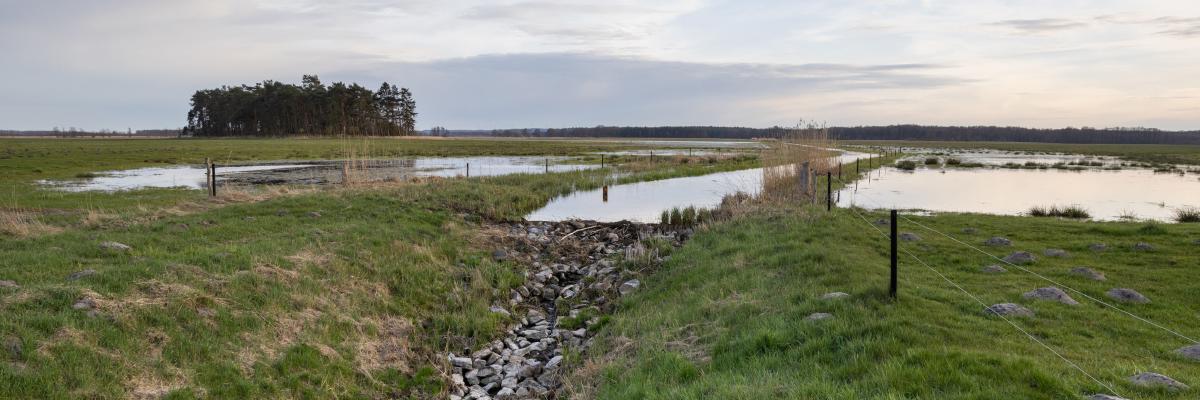
Artificial dam and flooded meadows along the channel Seegraben, Rewilding Oder Delta.
Florian Möllers / Rewilding Europe.
Core Topics
- The legal framework applicable to dam removal and key public entities
- Licensing procedure to remove a dam
Key Takeaways
Table of Contents
1. General considerations on dam removal
You may face the situation where there is a small dam on land you acquire or you are managing. In some instances, dams may be useful for rewilding purposes, for instance to boost the biodiversity of the landscape, but in others you may want to remove it if it is obsolete and it is blocking the natural flow of water.
If you wish to remove a small dam from your land, you need to follow certain steps and engage with public entities. Moreover, you should avoid causing
any damage to your land and to neighbouring property (see Rewilding in Poland: Liability to Neighbouring Landowners.
From a regulatory perspective, it is therefore crucial to properly prepare the dam removal process, including the identification of the required permits and the mitigation of the risk of damage.
2. What is there to know about removing a small dam?
First, you need to be aware of the legal framework that regulates water management in Poland and must be considered when planning to remove dams: the Water Law.1
EU-level regulations are also relevant, including provisions on nature restoration, which impose an obligation to identify artificial barriers in watercourses and — in certain cases — to remove them.1a
From an institutional perspective, a key role in this area is played by administrative authorities responsible for water management, in particular the State Water Management Authority “Polish Waters”2, represented by:
- the director of the regional water management authority;
- the director of the catchment management authority;
- the head of water supervision.
Depending on the nature of the project, other public administration authorities may also be competent, including the relevant ministers, the voivode, the starosta, the mayor, or the director of a maritime office.
Note that, although Wody Polskie is the key body with respect to water management, it is not the owner of public waters in Poland. State Treasury, other legal persons, or natural persons may own water courses. For instance, areas of the territorial sea, the internal sea waters, inland ground waterways, and underground waters belong to the State Treasury.
3. What is needed to remove a dam?
General provisions
The removal of a water barrier generally requires obtaining a water permit. The procedure for its issuance and the scope of the required documentation depend on the nature and location of the project. Water permit proceedings are conducted by the Polish Waters, in particular by the directors of the catchment management authorities, especially in cases where the removal of the barrier does not have a significant impact on the environment.
In certain cases, the removal of a barrier requires the prior obtaining of an environmental decision (see Rewilding in Poland: Developing Land), in particular where the barrier falls within one of the following categories:
- any dam that is higher than 1m;
- any dams within a protected conservation area (excluding dams lower than 1m based on the
respective environmental protection plan – see Rewilding in Poland: Protected Areas);
- any dams on natural flowing watercourses (where no other dams are located); or
- any dams on natural flowing watercourse on which other dams are constructed (within a 5km radius).
In addition, you will need to obtain a demolition permit (for removal of dams requiring an environmental decision) or to file a notification to remove any other dams. Demolition permits can be obtained, and notifications can be filed, according to the procedure applicable to building permits and notifications of construction works, described in Rewilding in Poland: Developing Land.
As the Water Law in Poland is complex, you are strongly advised to confirm all legal requirements with the water authorities prior to any action to prevent any liability.
Example
Landowner A intends to restore the natural course of the stream that crosses their land. This would require removing the small dam in the property that was used for irrigation in the past. The goal is to stop growing crops and allow natural succession. This would change the mixed nature of the land in a dynamic way depending on the season and volume of water.
Landowner A will have to consult the water authorities and, depending on specific water conditions in the area, obtain a water permit.
Landowner A must obtain an environmental permit and a demolition permit if any of the conditions listed above apply (see section 3).
If none of those conditions apply, it is sufficient to submit a notification of demolition. This will be in the cases of smaller dams (up to 1m) situated outside of inland watercourses, national parks, nature reserves, and landscape parks (and their buffer zones).
Landowner A should note that the process of acquiring a demolition permit or of submitting a demolition notification follows the rules on building permits and notifications of construction works (see note on Rewilding in Poland: Developing Land).
Endnotes
- Act of 20 July 2017 – the Water Law: Prawo wodne; consolidated text published in the Journal of Laws of 2021, item 2233, as amended.
1a. Regulation (EU) 2024/1991 of the European Parliament and of the Council on nature restoration.
- Państwowe Gospodarstwo Wodne Wody Polskie; Wody Polskie is a state-owned entity established in 2018 based on the Water Law, coordinating the administration and management of waters in Poland. It is a key administrative body responsible for issues related to water, represented by its internal bodies and representatives referred to in this section.


Contact Us

Elsie Blackshaw-Crosby