

Rewilding in Poland
Liability for Animals
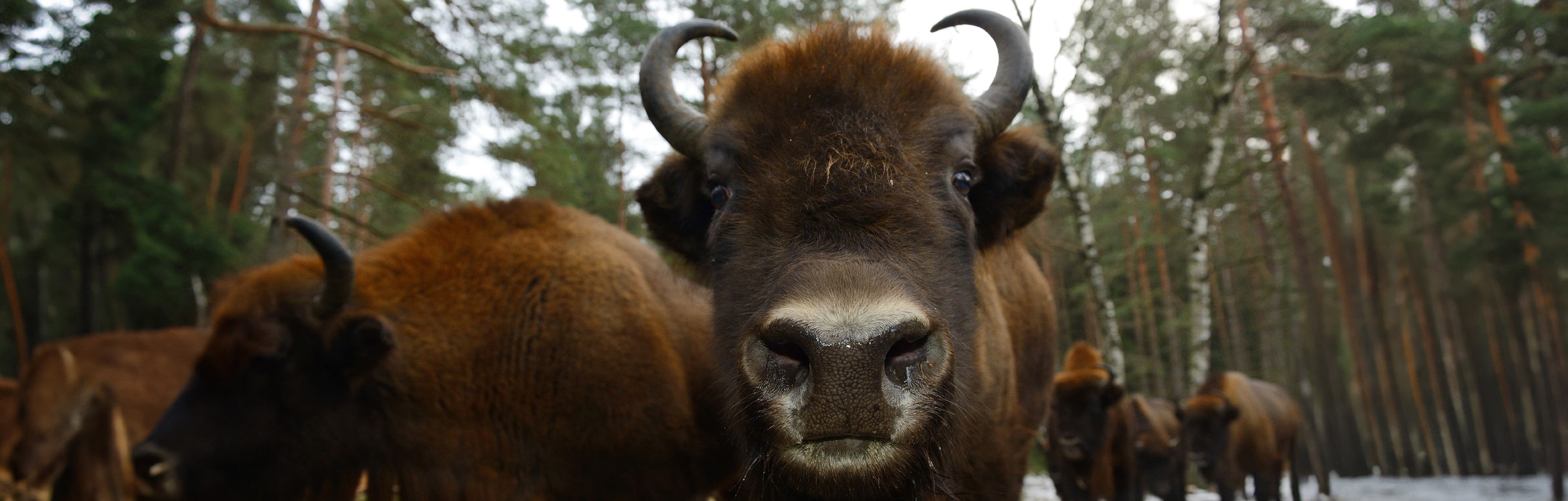
European bison (Bison bonasus), Drawsko Military area, Western Pomerania.
Staffan Widstrand / Rewilding Europe
Core Topics
- General rules of liability for damage caused by animals
- Legal definition of wild animals
- Special rules for protected species
Key Takeaways
Table of Contents
2.
1. What is the liability for damage caused by animals?
2. Who is liable for damage caused by domestic / kept animals?
The general rule applicable to liability for domestic / kept animals provides that, generally, whoever keeps an animal (as possessor) is liable for any damage and harm it causes.1 Therefore, to establish liability for damage caused by these animals, it is crucial to determine who is the keeper. This may be the State Treasury, a public authority, a private individual or a private entity, depending on who owns or is in possession of the animal.
Note that the person who handles the animal, but is not the keeper, may be also liable if they fail properly to supervise the animal and it causes damage. This means that the person responsible for the damage may be the person who, at the time the damage is caused, has a duty to keep watch over the animal for an extended period (e.g., feeds it, gives it shelter, etc.).2
It is worth noting that it is irrelevant whether the animal was under the direct supervision of its keeper at the time any damage or harm occurred, and the animal was being handled by another person. If it is not possible to establish who was responsible for the animal at the time the damage was caused, the keeper is still liable if this is a requirement under the rules of social coexistence.3
In the context of a rewilding project, rules for domestic / kept animals will apply when animals are kept prior to being released into the wild as part of a reintroduction program because at that point, there will be a keeper or possessor of those animals (see Rewilding in Poland: Wildlife Reintroductions).
However, there are no specific provisions regarding liability after releasing the animals into the wild or during the release itself. As such, general liability rules apply (see Rewilding in Poland: Public Access and Third-Party Liability on your Land).
To prevent any unpleasant surprises, taking all precautions to minimise and mitigate risks is highly recommended. In addition, targeted legal advice should be sought before undertaking a rewilding project that involves animals, and when faced with potential liability in relation to damage caused by such animals.
Where domestic / kept animals are abandoned or they escape, the owner / keeper essentially remains the owner or keeper until another person takes on that role. This may mean that kept animals that have escaped or were abandoned and are living freely in the wild will remain the responsibility of the last
keeper. They will not be considered wild animals in the sense discussed in section 3 below.
The ownership of kept animals that are no longer under the control of someone is transferred only after another person captures them with the
Example
As part of a rewilding project, Tatra chamois, no longer present in the area, are reintroduced to roam free across a vast fenced area without being managed or looked after in any way. One of the animals escapes the boundaries of the project, crosses a nearby road and is hit by a car, causing damage.
Because the area is fenced, it is considered that there is some degree of control over the animals, so, in this situation, the rewilding project is liable as they are considered the keeper (see section 2). Additionally, in this situation both the authority managing the road where the accident happened and the driver may also be liable, depending on specific circumstances.
Within the same project, a member of the public crosses the land with a dog unleashed. The dog approaches a group of Tatra chamois and attacks one of the animals. In defence, the animal fends off the dog with its horns injuring it.
In this case, the owner of the dog is liable for any damage it causes to the chamois. The fact that the dog was unleashed, which enabled the attack, may point to the fact that its owner did not take all necessary precautions to avoid damage.
Regarding the injuries suffered by the dog, the rewilding project may bear some responsibility. Here, it would be assessed on a case-by-case basis and there could be a case where liability is shared between the owner of the dog and the rewilding project.
To minimise and mitigate risks of this nature, it is highly recommended that practitioners make it explicitly clear to the public (by using signs / other notifications) that they are entering a rewilding project and what animals and dangers can be found in the area. There should be an explicit warning to the public to be careful and displays recommending good practices (e.g. always keep your dog on a leash) may be sufficient to avoid liability.
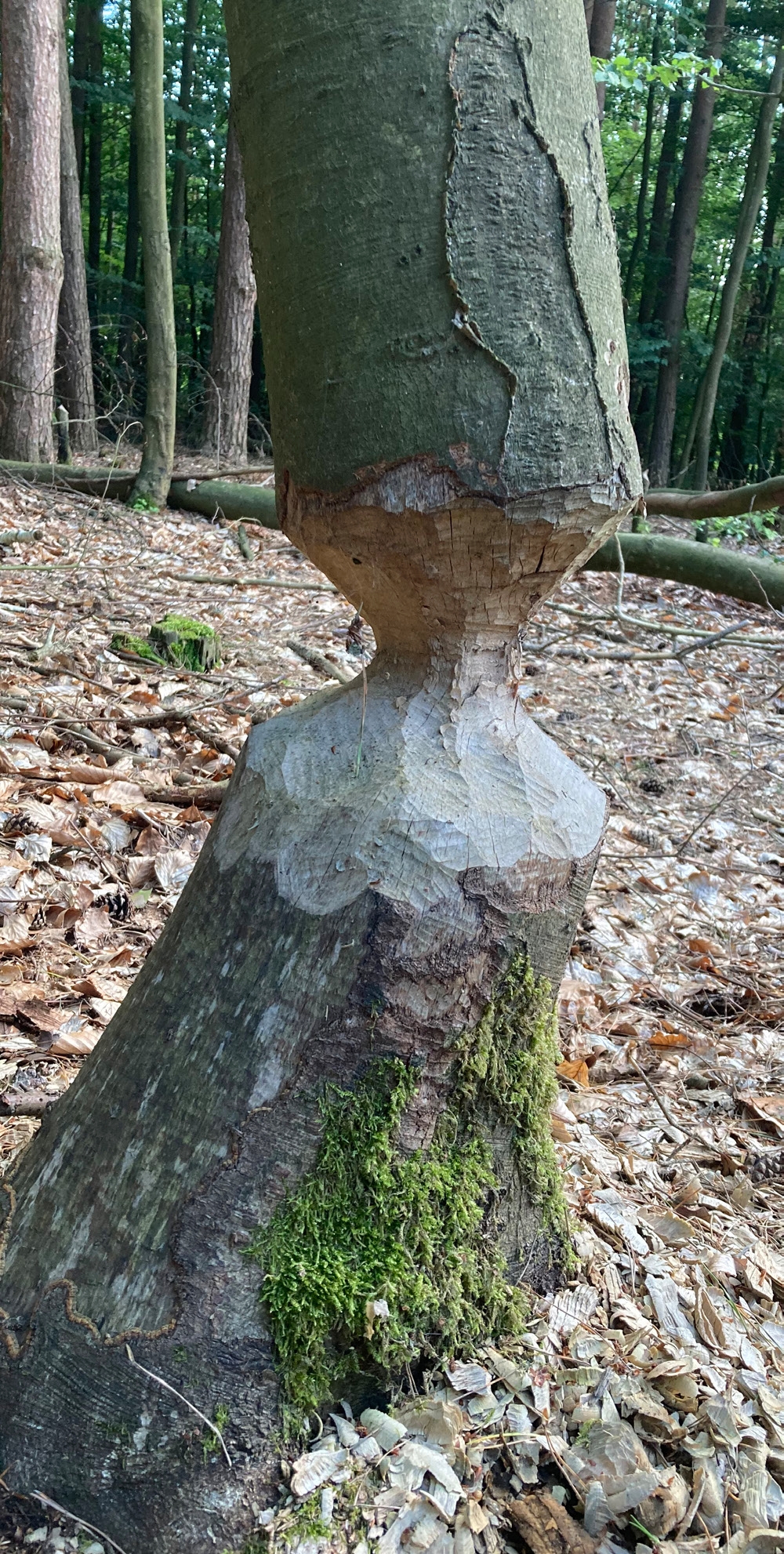
Beaver markings, Rewilding Oder Delta.
Raquel Filgueiras / Rewilding Europe
2.1. Criminal liability for damage caused by domestic / kept animals
When damage caused by domestic / kept animals has a criminal nature, the court may impose a penalty of restriction of liberty, a fine up to or exceeding PLN 1,000 or reprimand the perpetrator.5
The threshold here is (i) failing to observe the usual or prescribed precautions when handling an animal, and (ii) risk to life or human health caused by lack of caution from the keeper.
The measures vary according to the species and the danger posed by the animal in question.
3. Who is liable for damage caused by wild animals?
The general rule is that there is no liability for wild animals living freely in the wild. However, there are exceptions to this rule that are important to consider in the context of rewilding. But first, it is important to know exactly which animals are considered wild.
Polish law defines wild animals as non-domesticated animals living in conditions beyond human control.6 As such, the provisions of the Civil Code which apply to domestic / kept animals do not apply here. Examples of wild animals are wolves, lynx, elk, wildcat, grey seals, pelicans, Tatra chamois and bison, to the extent they are living freely in the wild without any human control.
Game species, i.e., species of wild animals with a hunting interest, are also considered wild animals, although there is specific legislation applicable to these species (see Rewilding in Poland: Hunting). Species such as red deer, fallow deer, roe deer, wild boar, fox, badger, pine marten, and pheasant are considered wild game species.7
Some species, like red deer, roe deer, pheasant, partridge, may be considered both game and freeliving species depending on the time of year. This happens because during no-hunting periods, these species are wild animals, whereas during hunting season, they are considered game. This is something to consider in case you are planning any rewilding activities involving these species.
Wild animals considered to be dangerous to human life and health are classified for legal purposes as “dangerous”.8 Wolves, lynx, bears, and many kinds of reptiles are some examples. Note that, although certain species are considered “dangerous”, this does not have an impact on liability for any damage caused by such animals.
Example
In the same scenario as above, consider now that the Tatra chamois are released into the wild with no enclosure as part of a reintroduction programme, and other wild animals are able to enter and exit the land freely. Some animals that have been living on the land roam onto a nearby road and one is hit by a passing car.
The general rule is that there is no liability for damage caused by free living animals, so if the accident occurred after the animals have been released, there is no liability for the rewilding project. However, in the case of reintroductions, it may be difficult to assess at which point in time the previously kept animal becomes a free-living animal. Such lack of clarity may, in turn, affect the legal assessment of such a case.
Because this is a road accident, it may be possible that the entity responsible for managing the road is liable e.g., if he did not comply with his obligation to put up a warning sign for the drivers.
As a last note, it is relevant to know the status of the animals causing the damage. In case the damage was caused by a Tatra chamois, the State Treasury may be called to pay compensation as this species is protected (section 3.1 below). However, if it was a wild animal with no protected status, the general rule applies.
3.1. Liability for damage caused by protected species or species living in protected areas
There is an important exception to the general rule that there is no liability for damage caused by freeliving wild animals. If the animal causing the damage has a protected status, or is living or present in a protected area, then the State Treasury is liable for the damage caused.
According to the Nature Conservation Act9 (NCA) and the Animal Protection Ordinance , the State Treasury may be liable for damage caused by:
- animals under strict species protection, as listed in Annex I of the Animal Protection Ordinance.10 This list is exhaustive and includes species such as wolves, lynx, bison, and brown bears;
- animals under partial protection, as listed in Annex II of the Animal Protection Ordinance. This list is set by default, meaning that it includes all protected species not listed in Annex I or other specific legislation. Species such as ermines, European beaver, scrub mouse, or otters are some examples; and
- wild game animals, occurring in national parks, protection zones of game animals, and in nature reserves11, in accordance with Hunting Legislation12 (see Rewilding in Poland: Hunting).
The NCA also established specific liability provisions for the State Treasury for specific damage caused by certain species, as follows:13
- damage caused by bison, in crops, agricultural produce, or on a forest farm;
- damage caused by wolves and/or lynx, in the livestock population;
- damage caused by bears, in apiaries, in the livestock headage, and in the agricultural crops;
- damage caused by beavers, on a farm, forest, or fish farms.
3.2. Liability for damage caused by game
Although game is considered the property of the State Treasury, liability is transferred to the managers of hunting zones, under some circumstances explained below. The State Treasury assigns liability under the hunting regulation to the extent that the hunting zone has a mandate to regulate the game population within their hunting area.
Accordingly, the lessee or manager of the hunting zone has the obligation to compensate for damage caused to crops by certain species of game (wild boars, elks, deer, fallow deer, and roe deer) while hunting.14 For more information on how the compensation mechanism works, please see Rewilding in Poland: Hunting.
In the situations not covered above, i.e., damage caused by game in protected areas and by game in hunting zones, there is residual liability for the State Treasury for damage caused by certain game species (wild boars, elks, deer, fallow deer, and roe deer) in areas not included in hunting zones.15
Example
A rewilding project manages a sanctuary into which wolves are reintroduced and allowed to roam. The sanctuary is fenced off with warnings against trespass. A passing walker ignores these warnings and climbs the fence. When they realise there are wolves in the area, they panic and try to escape by climbing the fence. At the top, they lose balance and fall off the fence to the outside of the sanctuary. They get hurt, but most of all, they get upset that there were no warning signs of the wolves.
According to general rules of Polish law, where the owner or manager of a property erects fences and signs to inform members of the public that they to do not have a right of entry to the property, they cannot be held liable for any harm suffered by trespassers who nonetheless enter the property. It is irrelevant that there were no signs specifically warning that the area was a wolf sanctuary. The walker is therefore responsible for his actions and cannot hold the landowner or manager responsible for his injury.
Endnotes
- Article 431 and Article 415 of Civil Code
- Article 431 of the Civil Code.
- Article 431 of the Civil Code.
- Professor Goettel’s opinion: M. Goettel, Podmioty “własności” zwierząt, Sytuacja zwierzęcia w prawie cywilnym, Warsaw, 2013.
- Act of 20 May 1971 Code of Minor Offences.
- General definition from the Act of 21 August 1997 on the protection of animals.
- Regulation of the Minister of the Environment of 11.03.2005 on the establishment of a list of game species.
- The attachments 1 and 2 to the Regulation of the Minister of Environment on animal species dangerous to human life and health. For the list of dangerous animal species, please refer to the Ordinance of the Minister of the Environment on the Animal Species Dangerous to Human Life and Health of 3 August 2011.
- Polish Nature Conservation Act of 16 April 2004, Journal of Laws 2004 No. 92 Pos. 880 (NCA). For more detail on the NCA see Rewilding in Poland: Wildlife Reintroductions.
- Ordinance of the Minister of the Environment on the Protection of Animals of 16 December 2016 (the Animal Protection Ordinance), Journal of Laws of 2016, item 2183.
- NCA, article 126, paras. 7 and 8.
- Hunting Law, article 50, para. 1.
- NCA, article 126, para. 1.
- Hunting Law, article 46, para. 1.
- Hunting Law, article 50, para. 1b.

Contact Us

Elsie Blackshaw-Crosby