


Rewilding in Portugal
Classified Areas
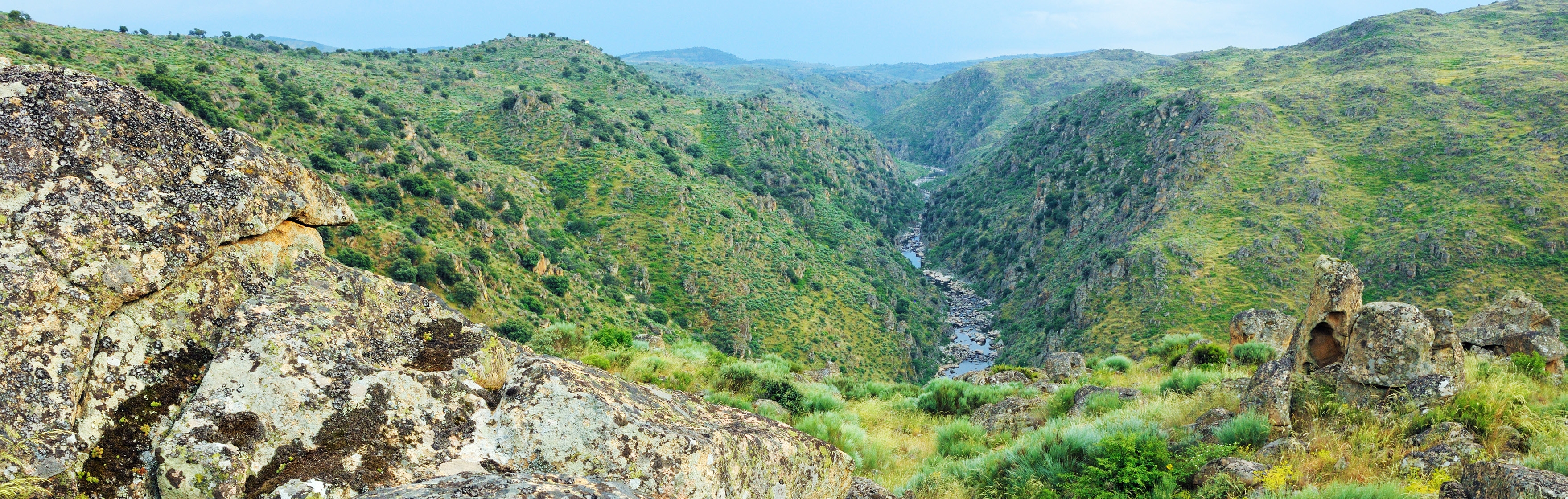
Faia Brava private protected area, Greater Côa valley.
Staffan Widstrand / Rewilding Europe
Core Topics
- Overview of National Network of Protected Areas, Natura 2000 network sites, and areas protected under international commitments and how they impact rewilding
- Rewilding activities in classified areas
Key Takeaways
Table of Contents
3.
4.
1. What relevant types of classified areas exist in Portugal?
The three main classifications of classified areas are the National Network of Protected Areas, the Natura 2000 network, and areas classified under international commitments assumed by the Portuguese state. They each have sub-classifications and they may each impact rewilding activities differently.1
In these areas, the conservation of nature and biodiversity is achieved by implementing “active conservation actions”, which correspond to the set of measures and intervention actions aimed at the
direct management of species, habitats, ecosystems and geosites.
In general terms, carrying out actions and projects, including rewilding projects, in these areas depends on the management rules specifically established and on obtaining favourable opinions or authorisations from the managing bodies. However, activities such as forestry, agriculture, livestock farming, hunting, or fishing may be carried out as a way of ensuring their maintenance or recovery to a favourable state.
2. National Network of Protected Areas
2.1. Overview
National Network of Protected Areas (“RNAP”)2 include:
- National parks;
- Natural parks;
- Natural reserves;
- Protected landscapes; and
- Natural monuments.
These include land, internal waters, and marine areas in which biodiversity or other natural features are of special importance due to their rarity, scientific, ecological, social, or scenic value. They, thus, require specific conservation and management actions.3
All subclassifications have guidelines establishing the objective and the measures that must be taken to achieve that objective.4 You must clearly understand the impact of the subclassifications on the management of rewilded land.
2.2. Management of RNAP
The national management body is the Institute of Nature Conservation and Forests (Instituto da Conservação da Natureza e Florestas / ICNF).5/6 The ICNF works as the centralised body and is always involved to some degree. However, protected areas of regional or local scope are managed by the corresponding Municipalities. Other public or private entities may be contractually engaged to provide ancillary management.7
The ICNF must seek the engagement of local authorities, private entities, organisations representing civil society and other public entities to develop active conservation actions. This engagement may be implemented by entering into partnerships, management agreements, and concession contracts, or by means of any other contractual instruments. 8
It may be necessary for you to engage with the ICNF about their land within RNAPs in relation to any proposed intervention actions directed at the management of species, habitats, ecosystems, and geosites. This engagement may also be necessary regarding the set of intervention actions associated with socio-economic activities, such as forestry, agriculture, livestock farming, hunting, or fishing, with significant implications for the management of species, habitats, ecosystems and geosites. 9
Example
The owner of a plot of land located in Vila do Conde wants to promote natural grazing and use of woodlands as grazing grounds. He also plans to open the landscape to guided tours from local businesses. The landowner is aware that his land has some kind of protected status, but it is not sure what type of protection exists and what can he do on his land.
Step one: the landowner should consult the Municipal Master Plan of Vila do Conde. It shows that part of his land is located in the Vila do Conde Regional Protected Landscape.
Step two: checking what this means – this protected landscape is a regional protected area, governed by a management regulation.10
Step three: assessing whether his plans have some kind of limitation – the regulation provides for various prohibited acts and activities, including (i) the prohibition of pedestrian and cycling circulation with exceptions of the beaches, marked paths, and within the management of the regional protected landscape.11 The scope of the landowner’s guided tours may therefore be limited.
Step four: look for other limitations – some activities depend on a mandatory binding opinion from the Board of Directors of the Regional Protected Landscape. Examples of such activities include the installation of sustainable economic activities and modification of existing ones, such as agriculture and forestry, the monitoring of wildlife, actions to conserve nature and biodiversity and environmental restoration.12
Step five: the landowner should approach the Board of Directors, the ICNF, and the Municipality to discuss his plans for the management of the land within the protected area and enter into an agreement that allows his activities.13
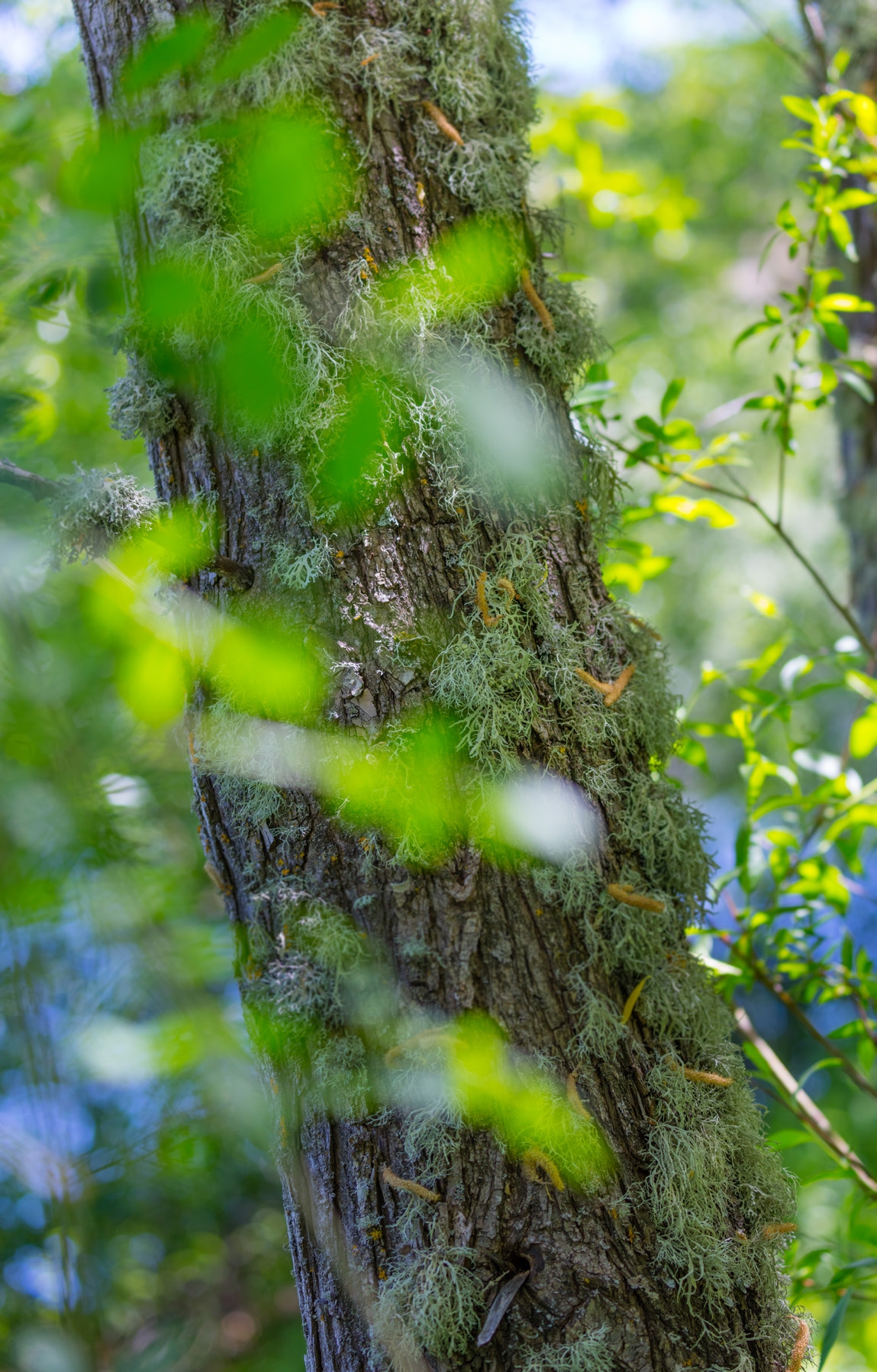
Pyrenean oak, Greater Côa Valley
Juan Carlos Muñoz / Rewilding Europe
3. Natura 2000: Special Protection Areas and Special Conservation Areas
National Network of Protected Areas
Natura 2000 sites are a network of core breeding and nesting sites for rare and threatened species, and some rare natural habitat types which are protected in their own right. It stretches across all 27 EU countries, both on land and at sea.14
The aim of the network is to ensure the long-term survival of Europe’s most valuable and threatened species and habitats, listed under both the Birds Directive15 and the Habitats Directive16/17. Although the goal is very similar, the Natura 2000 framework works differently from rewilding in the sense that the former is focused on one species, sometimes at the expense of the health of the ecosystem as a whole, while rewilding has a much more holistic approach. The health of an ecosystem, as a whole, benefits all species living there, even if that means that a particular species see their conditions slightly limited.
Under the Birds Directive, Member States designate Special Protection Areas (“ZPE”),18/19 while under the Habitats Directive, they submit lists of proposed Sites of Community Importance and once adopted, they are designated as Special Conservation Areas (“ZEC”).20/21
ZPE and ZEC areas are subject to conservation measures, which include land planning, management measures, environmental impact assessment and surveillance. Moreover, the management of sites on the National List of Sites and ZPE areas must also consider the guidelines provided by the Natura 2000 Sector Plan,22 which cover sectors like agriculture and pastoralism, forestry, construction works and infrastructure, and other economic activities.23
Some Natura 2000 areas are strictly protected nature reserves meaning that all human activities beyond what is necessary to achieve the site’s conservation objectives are prohibited. However, most of the network consists of privately owned areas where some degree of wider human intervention is allowed.
You need to be aware that there are a range of obligations to observe if their land is in or is located near a Natura 2000 site or (regardless of proximity), a project could have a significant impact on a Natura 2000 site.
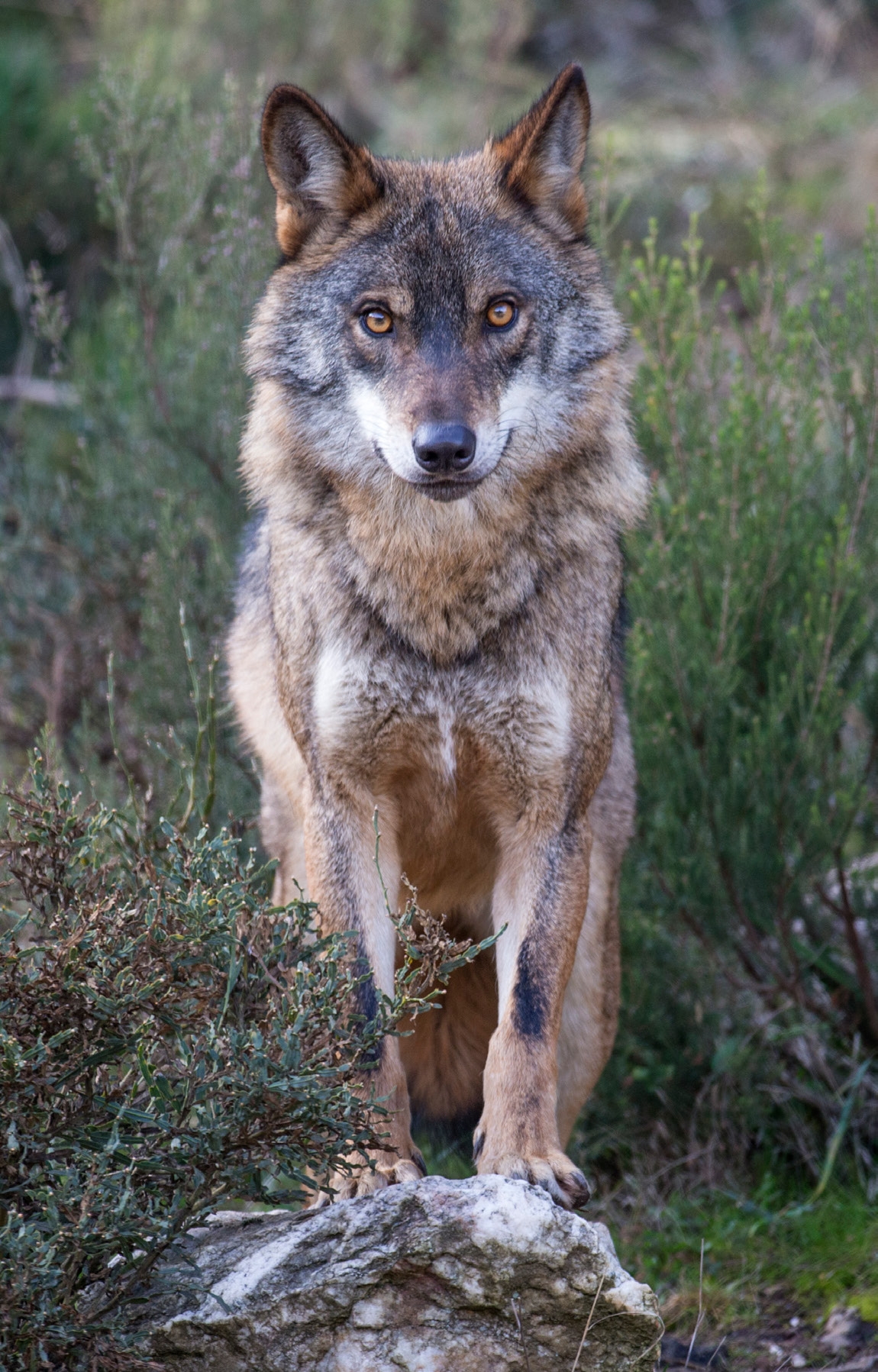
Iberian wolf, Greater Côa Valley
Daniel Allen / Rewilding Europe
3.1. Are there any assessment procedures applicable to rewilding projects in protected areas?
Yes, there is: the Environmental Incidences Assessment Procedure (EIncA Procedure).24
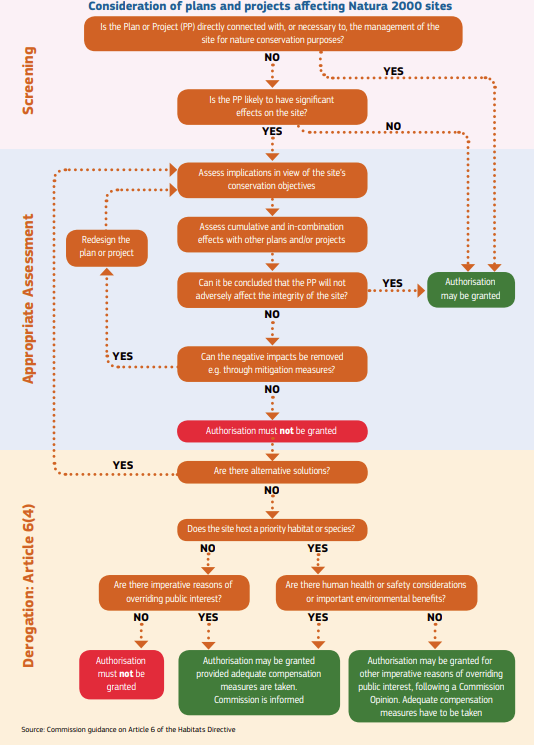
An EIncA Procedure takes place when the planned activities, either individually or in combination with other plans or projects, are likely to have a significant impact on protected areas, as listed in the National List of Sites of Natura 2000 and Sites of Community Interest.
Additionally, when impacts on the natural heritage are foreseeable, the special program for protected areas can make the practice of certain actions or projects dependent on environmental impact analysis.
An EIncA takes place before any licensing procedure as its outcomes will be part of the licensing decisionmaking process.
Whether or not an activity will “significantly impact the mentioned areas” will be a question of fact that will vary depending on the particular conservation objectives of the protected area and the proposed activities. You should seek advice or look for more information in the available materials to understand if they may need to comply with the EIncA Procedure.25
The EIncA Procedure is based on the Habitats Directive26 and it can be explained as follows:
Example
A rewilding organization entered into a management agreement of a landscape located near to a Natura 2000 site with the following protection features: high floristic importance and extremely wellpreserved patches of vegetation. In contrast, the plateaus and valleys of smooth relief are markedly cultivated or grazed. There is a landscape dichotomy guided by the alternation of agricultural mosaic areas and natural formations, a situation that favours the presence of protected habitats such holm oaks woods, juniper arborescent thickets, or black alder alluvial forests. The site is home to several protected species including the very rare endemic linaria coutinhoi.
Crossing the landscape visitors can walk ancestral paths along which marks of human presence and their coexistence with nature dating back to the Palaeolithic can be found. After millennia of changes in the ecosystem caused by human activity, a large part of the valley is currently in the process of rewilding.
The organization wants to ensure and facilitate natural processes, reconciling existing agricultural practices with biodiversity. To achieve this ambitious goal, the organization plans to reinforce natural forest with reforestation actions using native and locally adapted trees to prevent wildfires. They also want to mark the section of the ancestral path that crosses the land to prevent hikers from going off trail risking sensitive ecosystems.
The organization wants to submit a LIFE application to develop a reintroduction program of beavers. The landowners want these nature engineers to restore riverside ecosystems and help the conservation of riparian habitats. In turn, the flooding caused by the beavers may imperil the already vulnerable linaria coutinhoi.
The beaver is a Protected Species under the Natural Habitats Rules. Consequently, the capture and keeping of beavers is in principle prohibited. However, the law establishes that such actions may be authorised by ICNF for their reintroduction in Portugal. Actually, the reintroduction of beavers may be considered a reintroduction of an indigenous species since beavers populated Portugal in the past (see Rewilding in Portugal: Wildlife Reintroductions).
However, considering that this reintroduction will take place in an area next to a Natura 2000 site, it is possible that it will significantly affect the conservation objectives that led to the classification of the area in the Natura 2000 network. Therefore, the ICNF determines whether this action should be subject to a prior environmental assessment. The reintroduction of beavers will only be allowed when it has been ensured that it does not affect the integrity of the Natura 2000 network area.
4. Areas protected as internationally protected sites
4.1. Transboundary Protected Areas (“APTs”)
APTs are land or marine areas that include at least one protected area in Portugal which is adjacent to another protected area over the border in a neighbouring country.
Two examples of APTs exist, both in mainland Portugal: (i) the Tejo-Tajo International Park, comprising the Tejo Internacional Natural Park (in Portugal) and the Tajo International Natural Park (in Spain) and (ii) the GerêsXurés Transfrontier Park, comprising the Peneda-Gerês National Park (in Portugal) and the Lower Limia-Serra do Xurés Natural Park (in Spain).
4.2. Areas covered by supranational conservation designations (“ACS”)
RNAP and Natura 2000 sites, whose natural values are recognised as being of supranational relevance, may also be protected by additional supranational protection designations.
The areas classified under international commitments include: (i) the Biosphere Reserves,27 arising from UNESCO’s Man and Biosphere Programme; (ii) the Ramsar Sites,28 arising from the Convention on Wetlands of International Importance, especially as Waterfowl Habitat (Ramsar Convention); and (iii) the Geoparks.29
5. What practical measures can you take when dealing with classified areas?
5.1. Public consultation
The classification of protected areas must be preceded by a period of public discussion aimed at collecting observations and suggestions on the classification of the protected area.
The opening of the period of public discussion is made through a notice published in the Official Journal and disseminated through the media and ICNF website. This notice includes an indication of the period of discussion, the places where the final proposal for classification is available and how interested parties may present their comments or suggestions.
You can use the public consultation period to submit suggestions to try to influence the final text of the management regulation for the classified area in question.
5.2. Impact on rewilding activities
If you are undertaking rewilding activities within or near a classified area, you should consult the act by which the classified area was created, as well as its management regulations. The analysis of these documents may lead to the conclusion that any intended project (i) is permitted, (ii) is conditionally permitted (subject, for example, to authorisation or
opinion), (iii) is in principle prohibited but may exceptionally be permitted, (iv) or is totally prohibited.
Finally, there is also the possibility of private entities establishing partnerships, agreements, management and concession contracts, or any other contractual instruments with the classified area management bodies. By these contractual instruments, you may participate in the management of classified areas.
Endnotes
- Useful information can be found here: https://rea.apambiente.pt/content/sistema-nacional-de-%C3%A1reas-classificadas?language=pt-pt. You can even find information about the location and size of protected areas, overall or by specific classification.
- Article 11 of Decree Law 142/2008, as amended.
- Article 10(2) of Decree Law 142/2008, as amended.
- Articles 16 to 20 of Decree Law 142/2008, as amended.
- For further information, consult ICNF’s website: https://www.icnf.pt/oquefazemos/formularios.
- The protected areas that constitute the RNAP, even those of national scope, may be managed under a co-management model, which is characterised by the participation of the municipal agencies in the management of these areas. In this case, a co-management commission is created, which has the following composition: (i) a mayor from the municipalities covered by the protected area, who chairs the co-management commission; (ii) a representative of the ICNF; (iii) a representative of higher education institutions relevant to the sustainable development of the land covered by the protected area; (iv) a representative of environmental non-governmental organisations; (v) up to three representatives of other entities, not mentioned in the previous points, relevant to the sustainable development of the area covered by the protected area, depending on its complexity (article 7 of Decree-Law 116/2019, of August 21).
- Article 13(4) of Decree-Law 142/2008 of July 24
- Article 35 of Decree-Law 142/2008 of July 24.
- Article 6 of Decree-Law 142/2008 of July 24.
- Management Regulation of the Regional Protected Landscape of the Vila do Conde Coastline and Mindelo Ornithological Reserve, annexed to Notice 13081/2020 of September 4.
- Article 14 of Notice 13081/2020 of September 4.
- Article 15 of Notice 13081/2020 of September 4.
- Article 20 of Notice 13081/202, of September 4.
- Both directives were incorporated into Portuguese law by Decree Law 140/99 of 4 April, as amended.
- Article 4 of the Birds Directive.
- Article 6 Decree Law 140/99 of 4 Abril, as amended.
- Article 3 and 4 of the Habitats Directive.
- Article 5 Decree Law 140/99 of 4 Abril, as amended.
- Article 7 Decree Law 140/99 of 4 Abril, as amended.
- Article 10 of Decree Law 140/99, 24 April, as amended.
- For further information, consult the Guidelines issued by the European Commission available on: https://ec.europa.eu/environment/nature/natura2000/management/docs/art6/PT_art_6_guide_jun_2019.pdf.
- Article 6 of the Habitats Directive.
- There are currently six Biosphere Reserves on mainland Portugal.
- Since 1981 and until 2012 a total of 18 Ramsar Sites have been classified in mainland Portugal and 13 in the Autonomous Region of the Azores.
- Currently there are five UNESCO World Geoparks in Portugal: Naturtejo da Meseta Meridional, Arouca, Açores, Terras de Cavaleiros and Estrela.
- This is the case, for example, of the Ramsar sites of Estuário do Tejo, Ria Formosa, Paul de Arzila, Paul do Boquilobo, Estuário do Sado Estuary, Lagoa de St. André and Lagoa da Sancha, Sapal de Castro Marim, Planalto Superior da Serra da Estrela and Troço Zêzere River, and the Mira Minde Cliff and its associated springs, which are in protected areas of national scope and, therefore, the corresponding management plans apply to them.
- Several specific areas have instruments similar to management plans, as in the case of the Tagus-Tajo International Park, where the 2018-2022 Action Plan was being implemented, and in the Gerês-Xurés Transboundary Biosphere Reserve, the Common Action Plan 2022-2025 ((Microsoft Word - Plano de A\347\343o_RBT_Ger\352s-Xur\351s 2022) (icnf.pt)). In 2018, the Portugal Action Plan for Biosphere Reserves 2018-2025 was approved (plano-de-acao-de-portugal-para-as-reservas-da-biosfera-2018-2025.pdf (biosfera-mesetaiberica.com).


Contact Us

Elsie Blackshaw-Crosby