


Rewilding in Portugal
Hunting
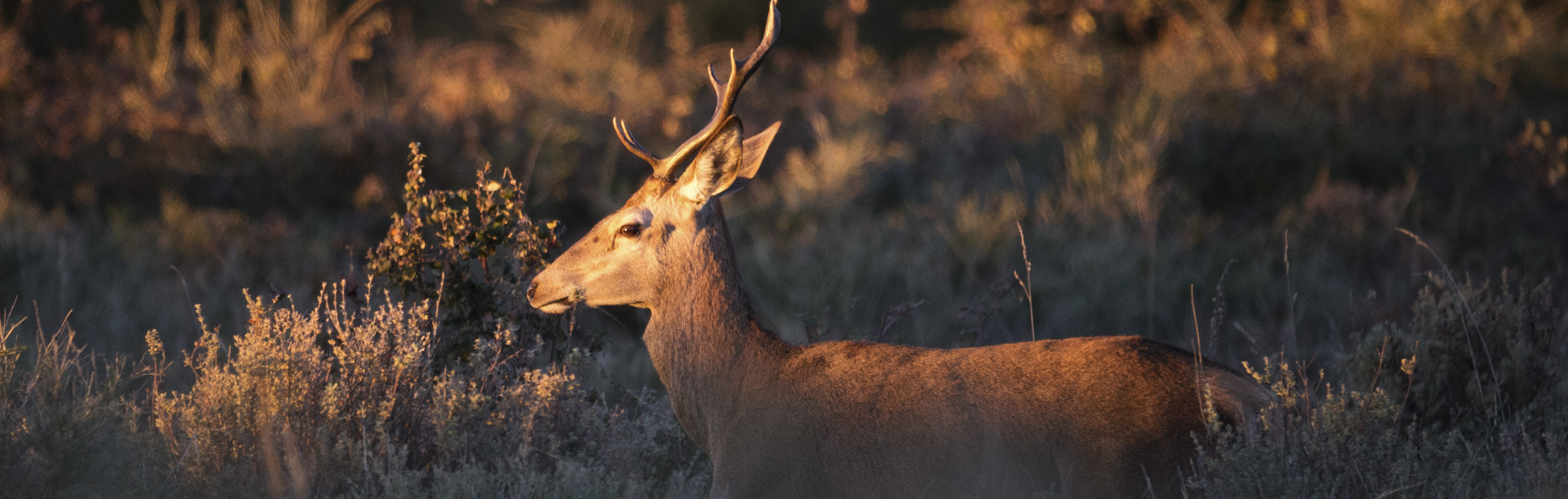
Red deer, Montesinho Natural Park.
Daniel Allen / Rewilding Europe
Core Topics
- The legal framework applicable to hunting
- Restrictions on hunting: no-hunting areas and conditional hunting areas
- Areas of right not to hunt
- How to create a ZCT
Key Takeaways
Table of Contents
2.
3.
4.
1. How are hunting laws framed?
Hunting laws1 aim to achieve the sustainable management, development, and protection of national game resources. National hunting policies are developed from a set of guidelines, some of which may be relevant to rewilding, including:
- acknowledgement that hunting resources constitute natural and renewable assets that must be managed in a sustainable manner, respecting the principles of nature conservation and preservation of biodiversity; and
- the “right not to hunt” is recognised and defined as a principle under which owners, users2 and lessees are entitled to claim that hunting is prohibited on their land. This approach to hunting is explained below (section 4).
2. How do Hunting Areas work?
The national territory where hunting is allowed is currently divided between formal areas that are subject to specific hunting management plans (“planos de ordenamento e exploração cinegética”) (referred to in this note as “Hunting Areas”) and informal areas, i.e., “free-hunting zones” with limited upkeep.
Hunting laws aim to ensure that any hunting activity is carried out only in Hunting Areas, complying with principles of sustainability and rational use of gaming resources. The goal is to end the existence of what are known as “free-hunting areas” where no specific entity is responsible for the management of hunting resources and where hunting activities are sparsely regulated.3 About 80% of hunting territory is now included in Hunting Areas and subject to management plans and the goal is to increase this to 100%4.
2.1. Are there different types of Hunting Areas?
Details about the existing Hunting Areas and their applicable plans are available on the ICNF website. There are four types of Hunting Areas:5/6
- National Hunting Zones (ZCN);
- Municipal Hunting Zones (ZCM);
- Associative Hunting Zones (ZCA); and
- Tourist Hunting Zones (ZCT).
From the four types of Hunting Areas, ZCTs may be of particular interest because they give the landholder control over access and hunting activities within the ZCT. This means that only hunters that have the landholder’s express permission are entitled to hunt in that area. For more detail on ZCTs, see section 5 below.
2.2. What level of regulation is there for hunting?
Hunting is regulated by five types of plans:7
- planning and hunting management plans (planos de ordenamento e gestão cinegética) required in ZCAs and ZCTs;
- management plans (planos de gestão) required in ZCMs;
- annual exploitation plans (planos anuais de exploração) required in ZCMs;
- global management plans applicable to different hunting zones to manage a particular game species (planos globais de gestão); and
- specific management plans applicable to areas with a particular incidence of migratory birds (planos específicos de gestão).
To understand the rules applicable to any Hunting Area, you need to know which plan is applicable. To know how to comply with the applicable plan, you should consult the ICNF website.
Roe deer in a high grass meadow
Nelleke de Weerd / Rewilding Europe
3. What hunting restrictions exist?
3.1. No-hunting Areas
Areas where hunting is absolutely prohibited include:8
- strict protection zones within classified areas;9
- sites designated as no hunting zones by Order of the respective ministries where specific nature conservation interests are at stake;10
- protection areas, including:11
- populated areas, bathing areas, land adjacent to schools, hospitals, nursing homes, military or security facilities, lighthouses, radioelectric stations, maritime and fluvial ports, airports, tourist resorts, camping areas, industrial and farming facilities and to and any contiguous land attached to the above areas within a 500m protection range;
national roads, train tracks, and adjacent areas within a 100m protection range; - aerodromes, cemeteries, and municipal roads;
- properties with fruit and vegetable crops, excluding olive crops, from budding until the end of harvest;
- “cattle parking” (land used for orderly livestock grazing in compartmentalised areas);
- populated areas, bathing areas, land adjacent to schools, hospitals, nursing homes, military or security facilities, lighthouses, radioelectric stations, maritime and fluvial ports, airports, tourist resorts, camping areas, industrial and farming facilities and to and any contiguous land attached to the above areas within a 500m protection range;
- apiaries and lofts, as well as any land surrounding them, within a 100m protection range;
- olive and fruit groves and vineyards with drip irrigation and micro sprinkler systems; and
- land occupied with arable crops and land used for sowing or planting forest species with an average height of less than 80cm.
Note that the areas identified in v. and viii. above must be identified with adequate signage for the hunting prohibition to be enforceable against third parties.12
- Sanctuary Areas13
These are areas where hunting is not allowed unless it becomes strictly necessary for the control of specimen numbers of a given species. In these cases, it is up to the ICNF to define the adequate control measures to implement.
The purpose of sanctuaries is to ensure the protection of non-game species and the conservation or fostering of game species.
Sanctuary areas are created by Order of the Ministry of Agriculture. The law provides that the Ministry of the Environment may also propose the creation of
sanctuary areas for the protection of non-game species, as deemed necessary.
The State is responsible for paying any compensation for any damage caused by the creation of sanctuary areas due to the limitation of hunting activities.
- Training Camps14
Training camps are designated areas for the practice of hunting activities, such as shooting training and training of hunting dogs. Training Camps may be created by hunting associations, dog breeding clubs, shooting clubs, and holders of Hunting Areas.15
3.2. Conditional Hunting Areas
There are also areas where hunting is conditional on obtaining the express authorisation of the owner of the properties:16
- yards, parks, or gardens adjacent to houses, as well as in any neighbouring properties within a 250m radius;
- walled properties;
- agricultural and forest land during certain periods of their vegetative cycle, when it is necessary to protect those crops and their respective productions and for this purpose, they have been signalled
accordingly under the applicable legal provisions; and
- in Hunting Areas where such consent is required, i.e., in ZCAs and ZCTs.
3.3. Protected areas
In protected areas, hunting is either restricted or conditional. The rules on hunting apply in these areas with a narrower scope and the decision-making process always requires the intervention of the ICNF.
For more information on these areas, refer to Rewilding in Portugal: Classified Areas.
Wild boar sow.
Staffan Widstrand / Rewilding Europe
4. What are areas of right not to hunt and how are they created?
As landowner, holder of usufruct rights, or lessee (if the lease agreement includes the right to game management in the property), you can request a ban on hunting on your land.17 After it is granted, the land is an area of right not to hunt.18
There is a caveat, though: to create a right not to hunt area, you cannot have a hunting license, or, in case of a legal entity, the entity cannot have the exploitation of hunting resources in its bylaws nor can any of the members of the board of directors have a hunting license.19
4.1. How to request for the land to be an area of right not to hunt?
You need to file a request to the ICNF, with the following information:20
- identification documents for the applicant;
- identification of the properties to which the right will attach, supported by digital maps;
- evidence that you own the land, hold usufruct rights, or have a lease over the land which includes game management; and
- evidence that there is no agreement to include the properties in a Hunting Area.
If granted, your right to not hunt is valid for a period between 6 and 12 years, and it is automatically renewed for the same term as originally granted. 21
4.2. What are the obligations involved?
Once your land is considered an area of right to not hunt, there are some obligations you need to comply with:22
- you should not allow any hunting to take place in the dedicated area;
- you must put up signs indicating that the land is an area of right to not hunt, and you need to the keep signage well-maintained;
- if your right to not hunt is extinguished, you need to remove signage within 30 days; and
- if you do not remove the signs, the competent authorities will, and you will be liable to pay all related expenses.
4.3. How can the right to not hunt be lost?
There are three situations where your right to not hunt is extinguished:23
- if and when the property rights in which the right to not hunt relies on end;
- if you get a hunting license or the legal entity includes game management activities in its bylaws, or any members of the entity’s board of directors obtain a hunting license; or
- if you violate or consent to the violation of the hunting prohibition.
5. The use of ZCTs to govern hunting: what are they and how are they created?
ZCTs are hunting areas in which the management is transferred to private entities with the goal of economically exploiting game resources. The minimum area is 400 hectares, and access to a ZCT is defined by the private rules applicable to it.24
Once land is designated as a ZCT, the owners of that land are able to control who enters the land for hunting. This means that a ZCT becomes a conditional hunting area in the sense of subsection 3.2 above, because consent is needed.
Rewilding Portugal created ZCTs on their landscapes. If you have questions regarding how they manage them, contact Rewilding Portugal at info@rewilding-portugal.com.
5.1. How is a ZCT created?
To create a ZCT, you need to file a request with the ICNF with the following:25
- the applicant’s identification documents;
- the type of hunting zone you wish to apply for, its concession period, and automatic renewal; and
- the total area to be integrated and location of the properties within the ZCT.
The following supporting materials must also be provided:
- perimeter delimitation of the required area intended, in digital format, including the location of any area in protected areas, if applicable;
- list identifying the properties to be integrated included in the ZCT and their respective owners;
- written agreements with the holders of rights over the properties; and
- the planning and hunting management plan, including:
- the mapping of land use and water resources available for fauna;
- a list of game species subject to exploitation and a qualitative estimation of the respective populations, as well as the measures to be implemented for their promotion and conservation;
- processes to estimate numbers of non-migratory game species; and
- identification of the individual responsible for the hunting exploitation plan.
Once your request is approved, an order approving the ZCT is issued, specifying:: (i) the identification of the holder of the concession; (ii) the type of hunting area; (iii) the area and location of the land covered by the hunting concession; and (iv) the concession period and renewals. 26
The concession period is granted for periods between 6 and 12 years, renewable automatically.27
5.2. What are the obligations of a holder of a concession for a ZCT?
As the manager of a ZCT, you must:28
- put up and keep in a good state signage of the ZCT;
- comply with the regulations governing hunting, applicable to ZCTs;
- pay the annual fee;29
- execute the planning and hunting management plan;
- inform the ICNF of the annual results of the hunting season, as well as the number, nationality, and capacity of users, by 15 June each year; noting that if the deadline is not met, no hunting can take place until the annual results are delivered to the ICNF; and
- ensure that, tn the final two years of the ZCT’s term, the number of specimens of sedentary game species which are hunted does not exceed the average number of such species hunted in the two previous years. The ICNF may grant exceptions to this requirement.
As a manager, you must also update your hunting management plans whenever significant changes
occur in the environment that affect the species to be exploited and submit it to the ICNF.
5.3. How can a ZCT cease to exist?
A ZCT may cease to exist if: 30
- it is terminated by the management entity;
- its term expires; or
- it is terminated by the competent authority
The State may terminate a ZCT whenever (i) the concession ceases to serve the public interest; (ii) the management entity does not comply with its undertakings; or (iii) the State decides to suspend the automatic renewal.
Any termination of the ZCT does not preclude the owner’s rights to request a concession for the creation of a new ZCT. In practice, this means that if your ZCT ceases to exist, you can apply for a new one to be created.
Example
Landowner A owns a property located in a Hunting Area. They don’t want any hunting to take place on their property:
(1) Can they exclude their property from the Hunting Area? If so, what is involved in doing that?
With regards to ZCAs or ZCTs, if Landowner A did not consent to the inclusion of the area in such ZCA or ZCT, they can apply to the Ministry of Agriculture for their property to be excluded from the Hunting Area. If Landowner A agreed to the integration of its property in a Hunting Area, the agreement by means of which Landowner A granted their consent must be judicially terminated for the latter to be able to exclude their property from the Hunting Area.
(2) Are there any other mechanisms they could use to restrict hunting on their land, e.g., could they apply for their land to be declared a no-hunting area? How?
Yes. Landowner A could exercise their right not to hunt. Please refer to section 4 above.
(3) Regardless of the solution adopted, is there a way to stop hunters crossing their property, to hunt or just to pass by?
Hunters must comply with the rules applicable to private property and the Hunting Area in which the property is located (see Rewilding in Portugal: Public Access & Restrictions). As Landowner A’s land is in a Hunting Area, the answer to this question will depend on the rules applicable to that Hunting Area which may or may not allow landholders to limit access to hunters.
Example
Landowner A owns a property located in a Hunting Area. They don’t want any hunting to take place on their property:
(1) Can they exclude their property from the Hunting Area? If so, what is involved in doing that?
With regards to ZCAs or ZCTs, if Landowner A did not consent to the inclusion of the area in such ZCA or ZCT, they can apply to the Ministry of Agriculture for their property to be excluded from the Hunting Area. If Landowner A agreed to the integration of its property in a Hunting Area, the agreement by means of which Landowner A granted their consent must be judicially terminated for the latter to be able to exclude their property from the Hunting Area.
(2) Are there any other mechanisms they could use to restrict hunting on their land, e.g., could they apply for their land to be declared a no-hunting area? How?
Yes. Landowner A could exercise their right not to hunt. Please refer to section 4 above.
(3) Regardless of the solution adopted, is there a way to stop hunters crossing their property, to hunt or just to pass by?
Hunters must comply with the rules applicable to private property and the Hunting Area in which the property is located (see Rewilding in Portugal: Public Access & Restrictions). As Landowner A’s land is in a Hunting Area, the answer to this question will depend on the rules applicable to that Hunting Area which may or may not allow landholders to limit access to hunters.
Endnotes
- The hunting legal framework in Portugal is essentially comprised by Law no. 173/99, of 21 September, as amended and the Decree-Law no. 202/2004, of 18 august, as amended. In addition to these legal diplomas, several other administrative diplomas should be consulted. Please find the relevant legal documentation at https://www.icnf.pt/caca/cacaenquadramentolegal.
- Under usufruct rights duly created.
- In these areas, general rules apply (article 48, Law 173/99, of 21 September, as amended). As a result, game species are almost non-existing as there are no replacement or conservation concerns in freehunting areas.
- This remark was made by the former state secretary(https://www.rtp.pt/noticias/pais/governo-quer-ordenar-todo-territorio-acabando-regime-livre-sec-estado_n20784).
- You can check ICNF’s guidelines here: https://www.icnf.pt/api/file/doc/6fd6d2a4a3831456.
- Article 9, Decree Law 202/2004, 18 August, as amended and article 14, Law 173/99, 21 September, as amended.
- Article 8, Decree Law 202/2004, 18 August, as amended.
- Article 19, Law 173/99, of 21 September, as amended and Article 52 Decree Law 202/2004, of 18 August, as amended.
- Article 119, a), Decree Law 202/2004, of 18 August, as amended and article 19, 1, Law 173/99, of 21 September, as amended.
- Article 119, b), Decree Law 202/2004, of 18 August, as amended.
- Articles 19, (2) and 43, Law 173/99, of 21 September, as amended.
- Article 53, (2), Law 173/99, of 21 September, as amended.
- Article 19, (1), Law 173/99, of 21 September, as amended and article 54, Decree Law 202/2004, of 18 August, as amended.
- Article 19, 1, Law 173/99, of 21 September, as amended and article 55, Decree Law 202/2004, of 18 August, as amended.
- Please refer to Government Order no. 147/2018, dated 22 may.
- Article 18, Law 173/99, of 21 September, as amended and article 56, Decree Law 202/2004, of 18 August, as amended.
- Articles 57-62, Decree Law 202/2004, of 18 August, as amended.
- Article 57, (1), Decree Law 202/2004, of 18 August, as amended.
- Article 57, n. 2, Decree Law 202/2004, of 18 August, as amended.
- Article 58, Decree Law 202/2004, of 18 August, as amended.
- Article 59, Decree Law 202/2004, of 18 August, as amended.
- Article 62, Decree Law 202/2004, of 18 August, as amended.
- Article 61, Decree Law 202/2004, of 18 August, as amended.
- Articles 30, n. 2; 10, n. 2; and 31, n. 1, Decree Law 202/2004, 18 August, as amended.
- Article 35, Decree Law 202/2004, 18 August, as amended.
- Article 41, Decree Law 202/2004, 18 August, as amended.
- Article 33, Decree Law 202/2004, 18 August, as amended.
- Article 42, n. 1, Decree Law 202/2004, 18 August, as amended.
- For applicable fees https://www.icnf.pt/api/file/doc/7157d59a7d350cdc.
- Article 50, Decree Law 202/2004, 18 August, as amended.


Contact Us

Elsie Blackshaw-Crosby