


Rewilding in Portugal
Land and Wildfires
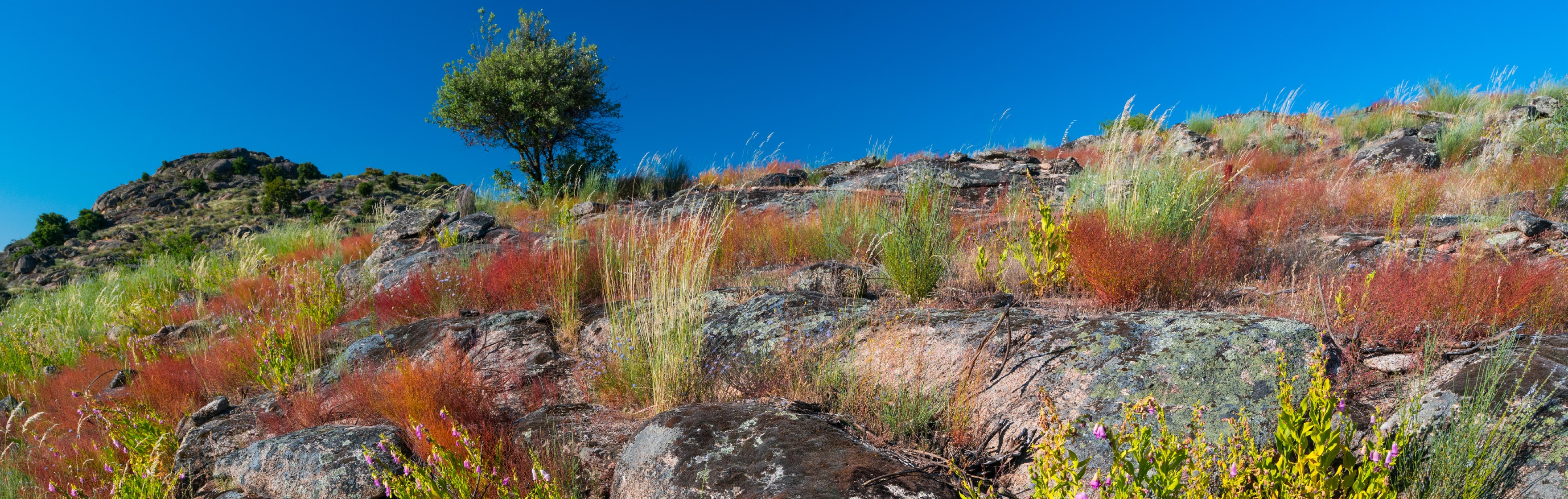
Natural regeneration after wildfire, Greater Côa Valley.
Juan Carlos Muñoz / Rewilding Europe
Core Topics
- Obligations to prevent rural wildfires
Key Takeaways
Table of Contents
1. What are my obligations to prevent wildfires?
As rural land comes with an increased risk of wildfires, there is legislation to safeguard against this risk.1 As a result, it is important for you to know your legal obligations regarding this matter and to know what you must do to prevent wildfires and how to react to them.
As an owner or manager of land, you have the general obligation to adopt the best self-protection and ignition reduction practices, to carry out fuel management to protect land, to report damage to the competent
authorities, and to participate in the recovery of burnt land.2 Moreover, everyone must alert the competent authorities immediately if a fire occurs.3
You must create firebreak areas, i.e., areas that are not occupied by forest/agricultural activity, that are totally or partially free of biomass. Among other purposes, those areas are intended to facilitate firefighter access and to reduce the area affected by large wildfires.4
2. Forest management obligations in relation to rural wildfires
Forest management plans and mechanisms must provide explicit measures to ensure that both vertical and horizontal forest breaks exist and ensure that adjacent parcels of land are of different flammability and combustibility. The aim of these measures is to reduce the risk of rural fire and to ensure the maximum resistance of the vegetation to the spread of fire.5
Furthermore, if you are planning on carrying out afforestation, reforestation, and forest reconversion actions:6
- Preference should be given to deciduous tree species or species that are not prone to fire.
- The continuity of the forest stands may not be possible for all forest stands. In practice, this means that your land may not be fully covered with trees, and you may need to parcel them to ensure that fire breaks exist.7
- Whenever there are water lines on the land, the maintenance or recovery of riverside galleries adapted to local conditions is a priority.
There are other rules that forestry activities need to follow to ensure good practices of wildfires prevention, such as:8
- Final or cultural cuts9 must result in a mixture of different types of vegetation with different levels of resilience to fire; surplus material from the cuts must be removed or treated.
- Within those cuts, invasive woody species must be controlled, and the regeneration of native species stands must be encouraged.
- Any wood or other flammable products resulting from forestry or agricultural activities, must not be deposited within or next to the 20m of fuel management strips.10
If a wildfire occurs, landowners and managers are responsible for taking the necessary rehabilitation actions and following good practices. Moreover, in areas affected by rural fires, owners and forestry producers must remove the trees and other burnt material in a minimum strip of 25m on each side of any road and rail infrastructures.11
Finally, concerning building activities, the general rule is that rural lands12 classified with the two highest categories of fire danger (according to the applicable plans) cannot be subject to allotment or construction works.13 Construction and expansion work on rural lands located in forest stands, or within 50m or less from them, are also conditioned.14
Endnotes
- Decree-Law 82/2021 of 13 October, as amended.
- Article 21 Decree-Law 82/2021 of 13 October, as amended.
- Article 54 Decree-Law 82/2021 of 13 October, as amended.
- Articles 47 and 48 Decree-Law 82/2021 of 13 October, as amended.
- Article 44 Decree-Law 82/2021 of 13 October, as amended.
- Article 44 Decree-Law 82/2021 of 13 October, as amended.
- Specifically, monospecific, and echogenic stands must not have a continuous area of more than 50 ha and must be compartmentalised, alternatively: (i) by the grid of fuel management strips or by other land uses with a low hazard of rural fire; (ii) by temporary or permanent water lines and the respective protection strips, suitably managed; (iii) or by high-density strips of trees.
- Articles 44 and 47 Decree-Law 82/2021 of 13 October, as amended.
- Cultural cuts aim to guide and enhance the stand. They include rolling (rolagem), cleaning of the stand, thinning, hedge trimming and shape of pruning - cfr. https://www.icnf.pt/api/file/doc/e550b62b6b44f397, pages 62 and 63.
- This applies to agricultural activities as well.
- Article 45(2)(e) and 45(3) of Decree-Law 82/2021 of 13 October, as amended. The good practices code seems not to have been made available yet. We recommend that you contact the ICNF for more information about this.
- With the exception of rural settlements. Rural settlements are defined in article 23(2)(d) of Regulatory Decree 15/2015 of 19 August. In brief, rural settlements correspond to built-up areas, with a dominant residential use and support activities located on rural land, with infrastructures and proximity services, but for which the classification of urban land is not appropriate. For further details on this definition, please see the mentioned article.
- Article 60 of Decree-Law 82/2021, of 13 October, as amended.
- Article 61 of Decree-Law 82/2021, of 13 October, as amended.


Contact Us

Elsie Blackshaw-Crosby