
SCOTLAND
PROTECTED AREAS


PROTECTED AREAS

CORE TOPICS:
- Management of and consents needed for sites of specific scientific interest.
- Protection offered and liabilities under the European regime.
KEY TAKEAWAYS:
- Rewilding in a protected area may be restricted by the area’s designated aims of protecting specific species and habitats.
- The SSSI regime limits activities within SSSI sites only and consent/permission must be granted for any activities falling within the site-specific list of “operations requiring consent”.
- It is an offence for anyone to intentionally or recklessly damage the protected natural features of any SSSI.
- Any activities which are likely to have a significant negative effect on the protected features of Special Areas of Conservation (SAC) and Special Protection Areas (SPA) will be restricted and may require a Habitats Regulation Assessment.
- It is an offence to intentionally or recklessly damage the natural feature by reason of which the land has been designated as a European site.
- Rewilding within a national park or National Scenic Area may be subject to stricter planning and development controls.
SCOTLAND
PROTECTED AREAS
1. SITES OF SPECIAL SCIENTIFIC INTEREST
1.1 Overview
Sites of Special Scientific Interest (“SSSIs”)1 are areas of land and water that are considered to best represent our natural heritage in terms of their flora, fauna, geology and/ or geomorphology. SSSIs are statutory designations made by NatureScot under the Nature Conservation (Scotland) Act 2004. There are over 1,400 in Scotland2 and SiteLink is a register that lists all SSSI sites in Scotland3 .
When a change in land use or other activities might affect a SSSI, NatureScot will make the decision-maker aware of the site’s designation.
SSSIs are statutory designations made by NatureScot under the Nature Conservation (Scotland) Act 2004.
If NatureScot plan to designate a new area they will contact all affected owners and occupiers to discuss their reasoning and how the designation would affect them. This is followed by a formal consultation process.
1.2 Management and Consents
When operating within a SSSI, rewilders should bear in mind that it is an offence for anyone to intentionally or recklessly damage the protected natural features of a SSSI.
To ensure that no offence is committed, owners and occupiers of land within a SSSI must manage land within the SSSI in accordance with the site’s management statement which has been created by NatureScot.
In addition, NatureScot’s consent will be needed to carry out “operations requiring consent” (unless planning permission has been granted on application or permission has been granted by another regulatory authority4 , with NatureScot having been consulted as part of those processes). The operations requiring consent are different for each SSSI and are designed to ensure that operations undertaken within the SSSI do not harm the protected features of the site.
Full information on operations requiring consent and applying for consent can be found on the SSSI consent website5 and in the site’s management pack.
The very nature of rewilding and its ecosystem approach to nature restoration may cause tensions in SSSIs which aim to protect individual features. It is therefore very important for rewilding projects within SSSIs to build a close relationship with NatureScot to understand how the designation may impact activities and find agreed ways forward. Within such cooperation, it may be helpful to understand that as part of their work to protect SSSIs, NatureScot must balance various interests alongside ecological protection, including the specific interests of owners / occupiers and local communities, social and economic development and the needs of agriculture, fisheries and forestry.6 This balancing act means that (according to NatureScot), a mutually acceptable solution can usually be found and consents are rarely outright refused.
EXAMPLE: IMPACT OF SSSI DESIGNATION ON REWILDING LAND
Landowner A is rewilding a 50-hectare site, part of which is covered by a SSSI designation because it is a good example of dwarf-shrub heath plant communities.
Landowner A notices that, by natural succession and regeneration, native, pioneer tree species such as birch, rowan and willow are colonising the upland heath area of her land and she would like to support this process and allow it to continue.
She would also like to introduce cattle and horses to graze the land and encourage the creation of a mosaic of habitats.
Part of the land in Rewilding Project A is covered by an SSSI. Landowner A therefore needs to ensure that her management of the land is in accordance with the management statement and that through her action she
does not either intentionally or recklessly damage the dwarf-shrub heath plant communities for which the site is designated. Causing such damage could amount to an offence.
She should discuss the natural succession and regeneration of native trees on the upland heath with NatureScot and work together to understand if there are ways to support these processes within the SSSI designated land.
If the use of natural grazing herbivores is not envisaged in the management statement, it may be an operation requiring consent, in which case NatureScot will need to be consulted and their consent granted before the animals are introduced to the land.
2. EUROPEAN PROTECTED SITES
2.1 Protected sites
The Habitats Regulations 1994 (as amended)7 are the applicable law in Scotland that protect sites that are internationally important for threatened habitats and species requiring strict protection. Sites can either be a Special Area of Conservation (“SAC”) or Special Protection Area (“SPA”). Prior to Brexit, these areas were part of the European-wide Natura 2000 network and are now referred to as “European Sites”.
The boundaries of all SACs and SPAs and details of the habitats and/or species for which a site is protected are identified on NatureScot’s SiteLink portal.
Each SAC is designated to protect one or more habitats and /or species listed in the Annexes of the Habitats Directive. Similarly, SPAs are selected to protect one or more of the bird species listed in Annex I of the Birds Directive.
SCOTLAND
PROTECTED AREAS
Scotland’s SACs also contain a number of priority habitats which benefit from even stricter protection. Details of these priority habitats are available on the NatureScot website.
If rewilding land exists within a European Site or near a European Site, rewilding interventions may be restricted by the underlying principle that the protected features and the integrity of these sites must not be significantly negatively impacted by any plans or projects (either individually or cumulatively), either within or outside the protected areas themselves.8 The impact of any traditional “development” such as the erection of buildings or fences, the creation of footpaths, or felling of trees will need to be considered in this context. More broadly, the impact of any change to how a European site is managed will have to be considered if it could negatively impact the protected features of a European Site. This could apply to a number of activities such as changing grazing management or the reintroduction of new species or the removal or building of dams or other water control in order to alter the flow of a watercourse.
2.2 Habitats Regulation Appraisal
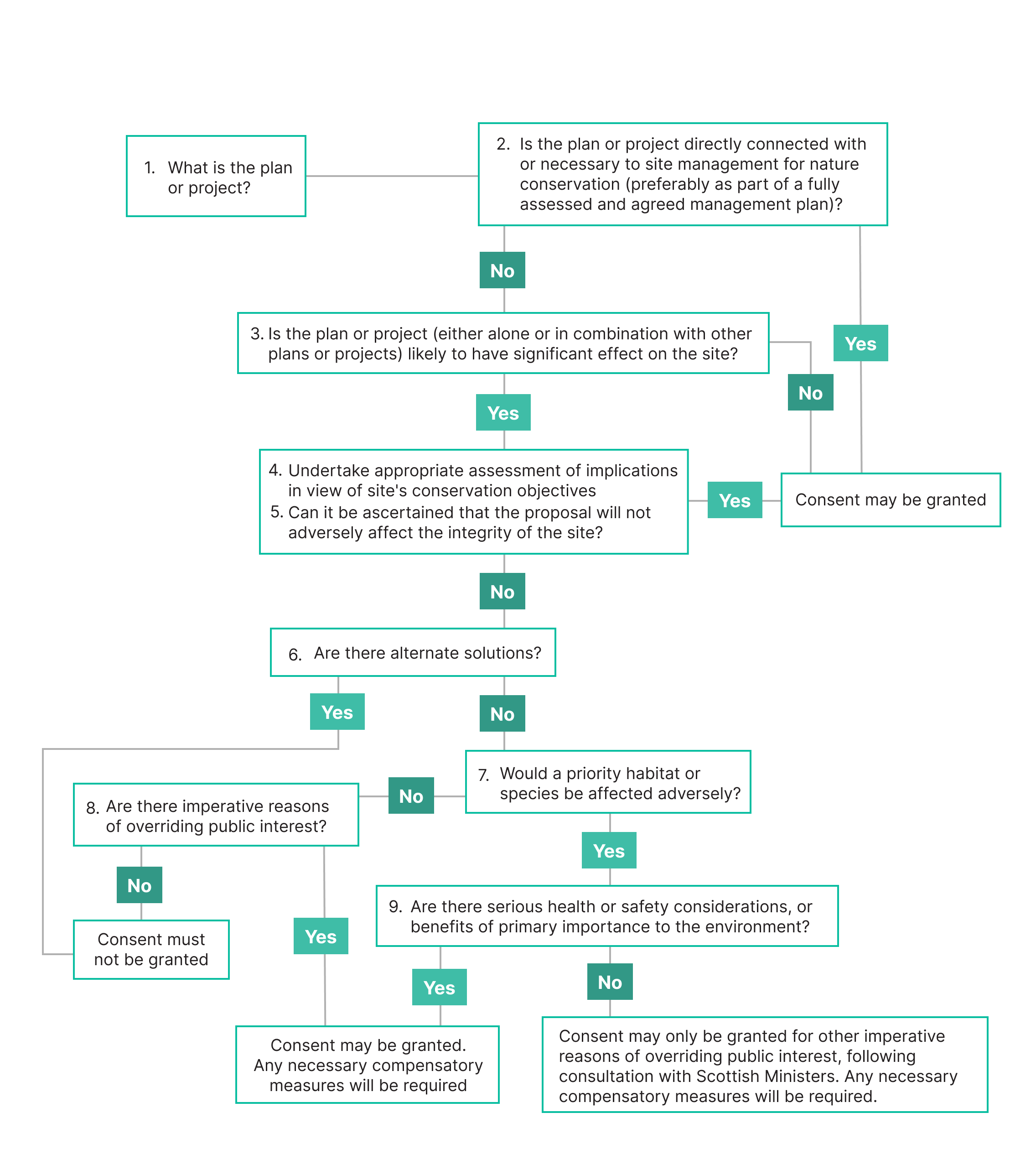
There is a process called the “Habitats Regulations Appraisal” (“HRA”) by which relevant authorities assess plans and projects with the potential to affect European sites.
An HRA is required when a plan or project requiring permissions or consents is likely to have a significant effect on a European site.
An HRA comprises both the process for determining whether an ‘appropriate assessment’ of the environmental risk is required, and the appropriate assessment itself. NatureScot provide the following useful flowchart as part of their guidance on considering plans and projects that could affect European Sites:
SCOTLAND
PROTECTED AREAS
Plan-making authorities must consult NatureScot as part of any appropriate assessment process and the basic rule is that consent may only be given if the appropriate assessment concludes that the plan would not adversely affect the integrity of any European site. In circumstances where adverse impacts are not ruled out, consent can still be granted if there are overriding reasons of public interest in allowing the plan or project to go ahead. Typically, this test will be very hard to satisfy and consent will only be granted for damaging central infrastructure projects rather than anything that a private landowner may wish to do. The test for such exceptions is even stricter where priority habitats are involved and consent may only be granted if (i) there are serious health and safety considerations; (ii) there are other wider important benefits to the environment; or (iii) there are imperative reasons of overriding public interest and following consultation with the Scottish Ministers.
Where such exceptional consents are granted (for both priority and non-priority habitats), compensatory measures will be required.
Please refer to NatureScot’s ‘Habitats regulations appraisal of plans: guidance for plan-making bodies in Scotland’9 and ‘The handling of mitigation in Habitats Regulations Appraisal – the People Over Wind CJEU judgement10’ for more detailed guidance.
2.3 Offences under the Habitats Regulations
In addition to the requirements for consents, the Regulations create an offence of intentionally or recklessly damaging the natural feature by reason of which the land has been designated as a European site. There are important exceptions to this offence where the damage is caused as part of a lawful operation and certain other criteria are satisfied.11
Rewilders working in European Sites should be mindful of this offence which carries with it the possibility of a fine.
EXAMPLE: IMPACT OF SPA DESIGNATION ON REWILDING ACTIVITIES
Landowner B is rewilding a 300-hectare upland area in the Highlands which includes a SPA which is designated to protect a unique wetland habitat.
Landowner B learns that a neighbouring landowner is planning significantly to increase the amount of drainage on his land and Landowner B thinks that this could negatively impact the protected wetland habitat.
Although the proposed increased drainage is not taking place in the SPA itself, as this could affect the SPA, it is still caught by the protections offered by the Habitats Regulations and will need to be subject to a Habitats Regulation Assessment if it is likely to have a significant effect on the integrity of a SPA.
This means that an appropriate assessment will need to be conducted to understand the likely impact of the increased drainage on the SPA. If a significant negative effect cannot be ruled out, NatureScot will not grant consent if there is an alternative solution. If an alternative solution is not available, NatureScot will only grant consent in the exceptional circumstance of there being an overriding and imperative public interest which is a very stringent test to satisfy.
3. OTHER PROTECTED SITES
Ramsar sites: A number of Scotland’s wetlands are designated as Ramsar sites under the Convention on Wetlands of International Importance 1971 (the “Ramsar Convention”). All Ramsar sites in Scotland are designated as SSSIs and many of them also benefit from protection as European protected sites.12
National Nature Reserves (“NNRs”): Sites designated as NNRs are recognised as being of national importance for one / a range of natural features and subject to management to continue or enhance those features in the long term; are publicly accessible to showcase these natural features; and are seen as likely to inspire people to value and enjoy Scotland’s natural environment.13 The majority of NNRs will also be designated as SSSIs and/or European protected sites and will also be subject to a management agreement which can be enforced by NatureScot.
Local designations: Local authorities are able to designate areas of locally important nature as Local Nature Conservation Sites14 (a non-statutory designation) or Local Nature Reserves15 (a statutory designation under the National Parks and Access to the Countryside Act 1949 (as amended)).
4. NATIONAL PARKS
Designation as a national park is a landscape designation which focuses more on planning and development controls rather than aiming specifically to protect wildlife and nature.
There are two national parks in Scotland; Loch Lomond and the Trossachs and the Cairngorms16.
The aims of the national parks are to:
- Conserve and enhance the natural and cultural heritage of the area;
- Promote sustainable use of the natural resources of the area;
- Promote understanding and enjoyment (including enjoyment in the form of recreation) of the special qualities of the area by the public; and
- Promote sustainable economic and social development of the area’s communities.
SCOTLAND
PROTECTED AREAS
Should conflict arise between any of these objectives in a particular circumstance, the National Parks (Scotland) Act 2000 requires that conservation of the natural and cultural heritage should take precedence.
The management strategy for each park is set out in the national park plan and the activities of rewilders will need to comply with these plans.
Both the Loch Lomond and the Trossachs17 and the Cairngorms18 National Park Authorities must prepare a development plan. Loch Lomond and the Trossachs has responsibility for development management in the park area19. Planning applications affecting land in the Cairngorms must be made to the relevant local authority although the Cairngorms National Park Authority must also be consulted20.
For rewilding projects in national parks, the stricter planning regime will be applicable and could restrict certain development projects.
5. NATIONAL SCENIC AREAS
National Scenic Areas (“NSA”) are broadly the equivalent to the Areas of Outstanding Natural Beauty found in England, Wales and Northern Ireland. Scotland’s 40 National Scenic Areas cover 13% of the land21 including spectacular mountain ranges (like the Skye Cuillins, Ben Nevis and Glencoe); dramatic island landscapes (in the Hebrides and Northern Isles); and picturesque, richly diverse scenery (such as the NSA in Perthshire, the Scottish Borders, and Dumfries and Galloway).
Scotland’s planning system safeguards the special qualities of NSA, with NatureScot acting in an advisory capacity, by ensuring protection from inappropriate development.
Scotland is in the process of finalising its Fourth National Planning Framework at present (“NPF4”). A revised draft of NPF4 was laid before the Scottish Parliament on 8 November
2022. The revised draft NPF4 notes that developments in National Scenic Areas will only be supported where:
- The objectives of designation and the overall integrity of the areas will not be compromised; or
- Any significant adverse effects on the qualities for which the area has been designated are clearly outweighed by social, environmental or economic benefits of national importance.
Thank you to Burness Paull LLP for their legal support in producing this briefing note.
This publication does not necessarily deal with every important topic or cover every aspect of the topics with which it deals. It is not designed to provide legal or other advice. You should not assume that the case studies apply to your situation and specific legal advice should be obtained.
The hyperlinks to legislation, guidance and various other external sources within this briefing are correct as of January 2023.
ENDNOTES
- Nature Conservation (Scotland) Act 2004
- Sites of Special Scientific Interest (SSSIs) | NatureScot
- SiteLink (nature.scot) for searching the register by using the interactive map or by entering the site name or local authority. Alternatively to look at the register boundary map, citation or ORC list Register of Sites of Special Scientific Interest - Registers of Scotland (ros.gov.uk)
- Scottish Ministers, local authorities, Crofters Commission, District Salmon Fisheries Boards, Forest and Land Scotland, and Scottish Environment Protection Agency are “regulatory bodies” pursuant to the Nature Conservation (Scotland) Act 2004
- Sites of Special Scientific Interest (SSSIs) - Consents | NatureScot
- Natural Heritage (Scotland) Act 1991, section 2.
- Conservation (Natural Habitats, &c.) Regulations 1994/2716 as amended and The Habitats Regulations: implementing species protection | NatureScot
- See NatureScot: Habitats Regulations Appraisal which specifies that “Any plan or project that could affect a European site – no matter how far away it is – should be subject to HRA”
- Habitats Regulations Appraisal of Plans - planmaking bodies in Scotland - Jan 2015.pdf (nature.scot)
- Guidance Note - The handling of mitigation in Habitats Regulations Appraisal – the People Over Wind CJEU judgement | NatureScot
- Habitats Regulations, section 18.
- NatureScot: Ramsar Sites
SCOTLAND
PROTECTED AREAS
- National Nature Reserve Selection Criteria and Standards
- NatureScot: Local Conservation Sites
- NatureScot: Local Nature Reserves
- Created under through the National Parks (Scotland) Act 2000
- https://www.lochlomond-trossachs.org/planning/ planning-guidance/
- https://cairngorms.co.uk/planning-development/
- Resources for making planning applications https://www.lochlomond-trossachs.org/planning/ planning-applications/
- Making an application - Cairngorms National Park Authority
- National Scenic Areas | NatureScot

This note is part of a range of information produced by Rewilding Britain and The Lifescape Project to provide practical guidance to rewilders. Each is designed to help rewilding practitioners across Britain overcome common barriers in their rewilding journey, as identified through conversations with members of our Rewilding Network.
Rewilding Britain’s Rewilding Network provides a central meeting point for landowners, land and project managers and local groups in Britain, offering opportunities for collaboration and allowing smaller landowners to take on larger-scale rewilding together. If you find this useful, please consider joining the Network, where those in Britain can explore these issues further with others in the same boat.

The Lifescape Project is a rewilding charity using a multi-disciplinary approach to achieve its mission of catalysing the creation, restoration and protection of wild landscapes. Lifescape’s legal team is working to support rewilders in understanding how the law applies to their activities and pursuing systemic legal change where needed to support the full potential of rewilding. These notes form part of Lifescape’s Rewilding Law Hub which aims to provide a legal resource centre for those wanting to manage land in accordance with rewilding principles.
We’d love to hear what you’ve found useful in these notes and where we can help fill gaps in the guidance so that we can make sure they remain an up-to-date practical tool for rewilders.
Get in touch with us at: Rewilding Britain: the Rewilding Network, www.rewildingbritain.org.uk/rewilding-network
The Lifescape Project: Elsie Blackshaw-Crosby, elsie.blackshaw@lifescapeproject.org