Bringing species back to their ancestral homes isn’t just a win for nature; it’s a proven catalyst for cultural revival and economic growth. The restoration of the white-tailed eagle to the Scottish Highlands is a prime example of how rewilding can transform a region ecologically, culturally, and economically.
Once a common sight, the white-tailed eagle was driven to extinction in the UK by the early 20th century due to human persecution and habitat pressure. To fix this, a dedicated reintroduction effort began on the Isle of Rùm, near Mull in 1975, using chicks brought over from Norway. Following that initial success, two additional reintroduction phases (1993–1998 and 2007–2012) helped the population take flight across the west coast.
The current population stands at approximately 150 breeding pairs across Scotland, with 22 of these pairs resident on the Isle of Mull. The economic impact includes the generation of between £5-8 million of discrete tourist expenditure annually, of which 40% is expected to be spent locally, helping to support up to 160 local jobs in the tourism, hospitality and retail sectors.
Economic benefits have also been seen with the reintroduction of beavers to Britain after a 400-year absence, as ‘ecosystem engineers.’ Beaver dams act as natural sponges, holding up to one million litres of water and slowing river flows. In Devon, they reduced peak flood volume by 30%, a nature-based response to the UK’s £1 billion annual flood damage.
Why economics matters for reintroductions
Species reintroductions are typically presented with strong ecological and even ethical rationales, but the value of adding an economic framing is often overlooked. An economic piece strengthens the case for species reintroductions, by highlighting the value of restoring healthy, resilient ecosystems in quantitative and sometimes monetary terms that are both widely understood and used to determine the feasibility of investments relating to land use and management.
At the most fundamental level, all social and economic activity depends on functioning ecosystems: a sentiment rewilders should not be shy to express.
Species reintroductions can reshape how landscapes are used, valued, and experienced. While reintroduction projects can bring costs—such as livestock predation or the need for adapted land management—they also offer profound rewards, as evidenced by the eagles on the Isle of Mull. By supporting rural employment through tourism, enabling ecosystem service markets, strengthening catchments (as beavers do), and enriching cultural identity in specific regions, species reintroduction can help shape an economic landscape where the challenges of coexistence are balanced by long-term and diverse benefits.
How we approach the economics
We approach species reintroductions as land management interventions, using economic analysis to understand their wider impacts on landscapes, communities, and rural economies. We do this across three levels.
First, we use a natural capital lens to understand how species reintroductions affect landscapes over time by linking ecological processes to benefits for people and the economy, including improved soil health and flood regulation, as well as more resilient agriculture and forestry. In practice, this means combining biophysical and economic data to quantify and - where appropriate - value these effects in a natural capital account or wider economic assessment. In this way, reintroductions can be considered as part of land management and restoration decision.
Secondly, at the project or species level, we look at whether reintroductions make economic sense using tools such as cost–benefit analysis, applied cautiously and alongside qualitative evidence. This gives a clearer picture of the likely scale of impacts, the main trade-offs, and who is likely to benefit or bear the costs.
Lastly, we work within policy and regulatory contexts, using economic evidence to inform and support debate on incentives such as ELM schemes and wider land-use policy. This helps position species reintroductions as part of delivering 30 × 30 and building resilient, nature-centred rural economies, rather than as isolated ecological projects.
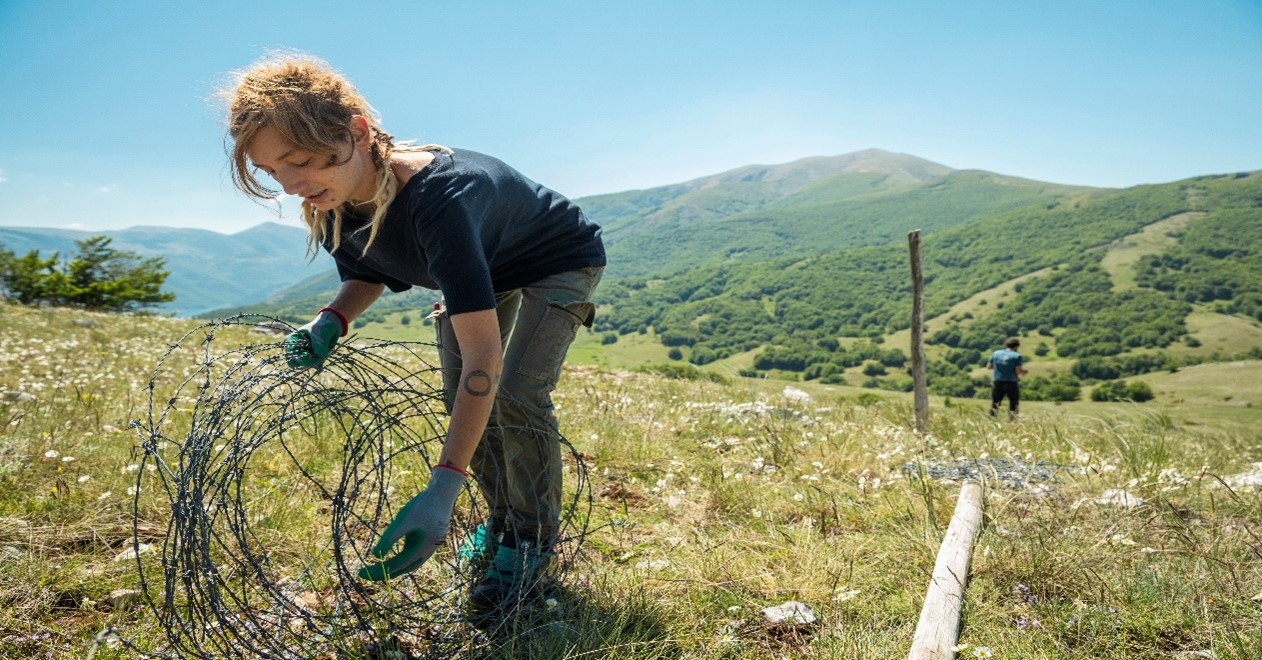
Removing barbed wire allows a wide range of animals to follow their natural pathways, Central Apennines, Italy (Credit: Bruno D’Amicis / Rewilding Europe). See Rewilding in Italy: Developing Land
What this looks like in our work
Economic considerations are central to the species reintroduction work at Lifescape.
Eagles: In a feasibility study conducted in conjunction with the University of Cumbria, AECOM, and Wildland Research, we outlined the potential for white-tailed eagles to bring at least 4,000 additional visitors per year to the Cumbrian coast, contributing a minimum of £0.6 million annually to the local economy.
Lynx: We are also investigating feasibility of reintroducing the Eurasian lynx to the UK. Predators such as lynx can act as keystone species and play a dramatic role in restoring ecosystems. Similar to beavers, lynx have the potential to restore the ecological structure of ecosystems, bringing associated economic benefits. For example, lynx have the potential to deliver cost savings for foresters by reducing the numbers of deer that damage trees through overgrazing.
Rewilded landscapes for multiple species reintroductions: The Natural Capital Laboratory in the Scottish Highlands continues to provide a space for learning how to monitor and measure the value of rewilding in natural capital terms. As species reintroductions continue to be planned and implemented on the site, the natural capital accounting approach will continue to develop and communicate the economic benefits that reintroductions can provide, from hairy wood ants to ospreys.
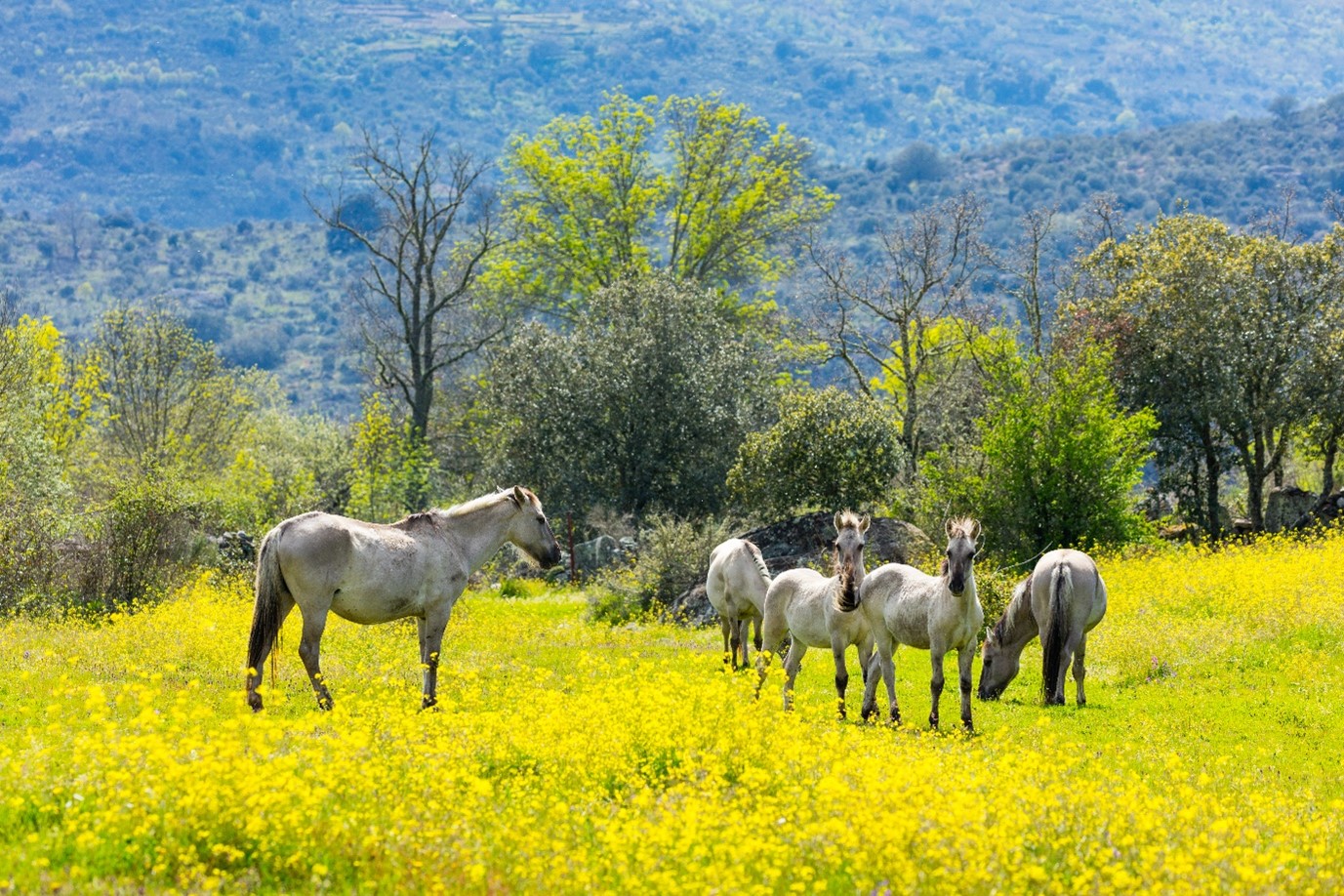
Sorraia horses grazing, Greater Côa Valley, Portugal (Credit: Juan Carlos Muñoz / Rewilding Europe). See Rewilding in Portugal: Grazing Rights
Where it gets tricky
Different species reintroductions bring different impacts depending, for example, on the type of species, social perceptions and local context. So, while we approach this work with a broad framework for assessment, we recognise that just as species differ in their ecological impact, their economic value and the methods used to measure it also vary.
For instance, some charismatic species can generate direct financial opportunities, such as through local tourism and nature markets like biodiversity credits. On the other hand, lesser-known species can play a critical role in keeping ecosystems functioning without generating any conspicuous financial returns. The wood ants we recently introduced are not expected to create a noticeable boost to the local economy, but they are already having a clear and visible positive effect on the ecosystem, including building microhabitats for smaller insects, and facilitating the arrival of the cinara spp. of aphid, helping to balance insect diversity.
Tourism is often presented as a ‘silver bullet’ for the economic case for species reintroductions, this can be misleading. One of the key challenges, however, is that economic benefits do not always emerge in the ways most easily communicated or measured. For example, reintroductions of insects will rarely inspire tourism to an economically relevant extent, even in the case of strikingly beautiful butterflies such as the large blue, which was reintroduced from Sweden having become extinct in the UK in the 1970s. However small, uncharismatic species such as insects and soil microbes can often be the most important in terms of economic value. It is well cited within environmental and agricultural economic research that populations of pollinating insects are drastically in decline, putting fruit and vegetable crops at risk: in the UK, pollinator services are valued at an estimated £600 million per year. However, the complex ecological interactions of these tiny species make them very difficult to value economically, particularly when studies are focussed on a particular place, and there are as yet no in-depth studies evaluating the pollination services of reintroduced insects.
This highlights a broader challenge for economic assessment. Seen through a natural capital lens, many species’ economic importance sits in the wider economic benefits they underpin, not just in direct revenue or cash flows. Impacts that are difficult to quantify or monetise do not, and should not, reflect a low importance. More often, a difficulty in measurement reflects the limits of conventional economic metrics rather than a lack of value in nature or species themselves. This is particularly true when linking proposed ecosystem improvement (restoration) to long-term societal and ecological wellbeing. Biodiversity is often excluded from site-specific natural capital accounts, despite it being cited by practitioners as a core component of value.
Conclusion
Designing and implementing species reintroductions projects goes beyond ecological considerations, as these species can significantly shape how landscapes are valued and used by people. Bringing economic perspectives into the design around why, how and where reintroductions can occur, helps ensure we are in tune with national priorities and policies, and grounded in the realities of people and place.